

Arc Fault Detection Device Manufacturer: Essential Selection Criteria for Electrical Safety
2026-09-07
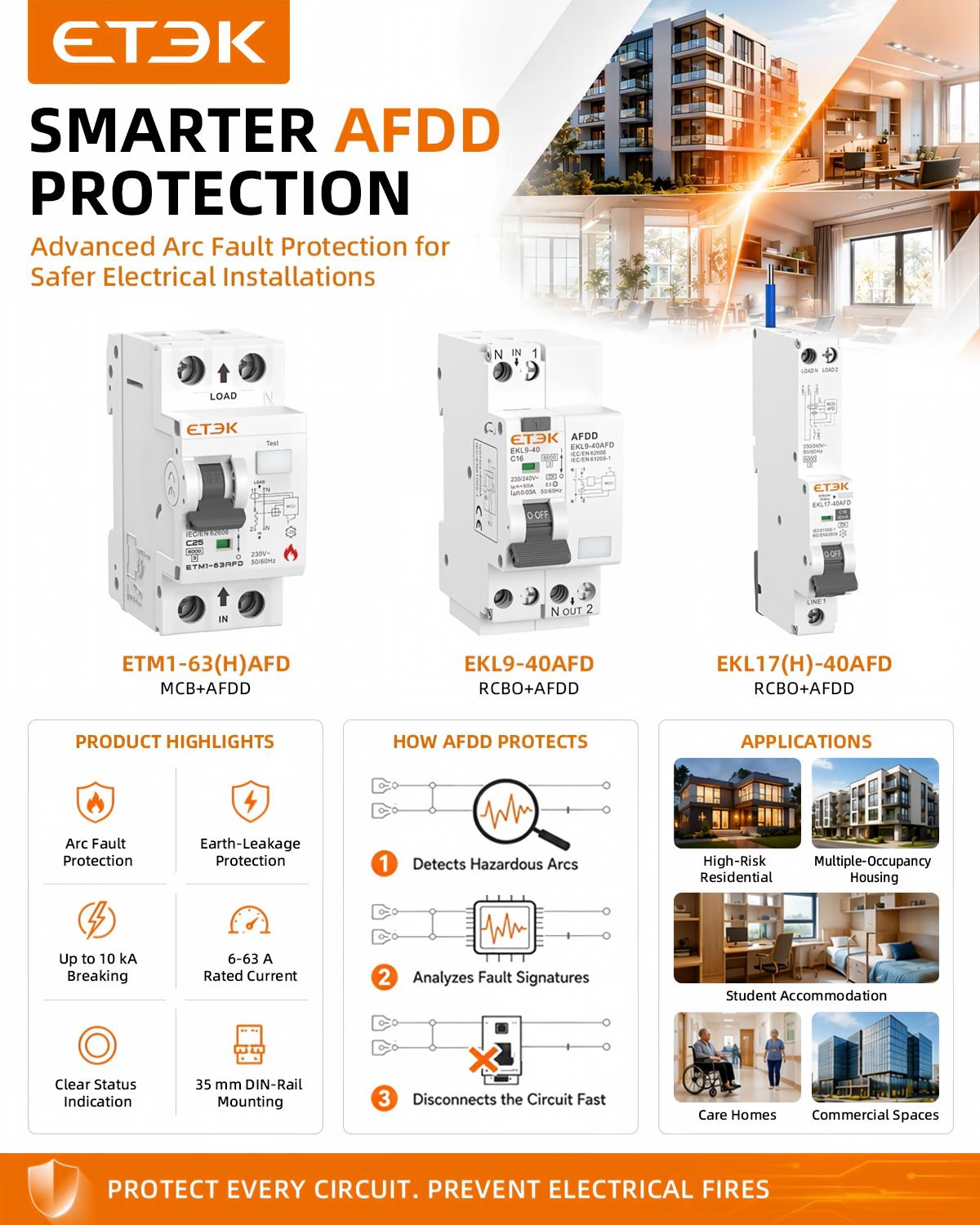
Selecting an arc fault detection device manufacturer is rarely about a single spec. It is about trusting a product to catch the invisible, high-temperature arcing that can ignite a fire in seconds. That trust is hard to earn. ETEK has built its reputation on that exact challenge, but what separates a dependable supplier from a costly gamble? The answer lies in a handful of essential criteria you cannot afford to overlook.
UL, IEC, and the Fine Print: What Your Inspector Won't Overlook
The label on a component is often read as a simple stamp of approval, but inspectors pay far more attention to the fine print than most people realize. A UL listing, for instance, doesn't mean a product can be used in any arrangement or environment. The listing file typically spells out conditions of acceptability—specific mounting clearances, ambient temperature limits, or compatible enclosure types—and those details carry just as much weight as the mark itself. If the installation strays from what the certifier actually tested, the inspection stops being a formality.
IEC standards add another layer of nuance because they are often written for manufacturers and testing laboratories rather than installers. A device that carries an IEC-based CB scheme certificate may still require a national difference evaluation before it is accepted in a given market. Inspectors who deal with mixed international equipment look for the exact version of the standard, any country-specific deviations, and whether the marking matches the voltage and frequency on site. The mismatch is usually hidden in the suffix or revision date, not the headline certification.
There is also the quiet trap of field modifications. Even a fully certified assembly can lose its standing once a contractor drills extra holes, swaps a power supply, or reroutes wiring in a way the original test report did not cover. Inspectors are trained to compare the installed condition against the construction described in the certification file, and they will not overlook a field evaluation requirement just because the original equipment carried a familiar logo.
Milliseconds Matter: Why Trip Speed Isn't Just a Spec Sheet Number
A circuit breaker's trip speed is often reduced to a single benchmark number on a datasheet, but that figure rarely captures what happens in the real world. The actual time between fault initiation and arc extinction shifts with current magnitude, ambient temperature, and even the mechanical wear of internal components. A breaker that clears a 10 kA fault in 8 milliseconds at 25°C might take 12 milliseconds at 40°C, and that gap can mean the difference between protected equipment and a cascading failure.
Beyond temperature, the shape of the fault current matters more than engineers often admit. A purely sinusoidal short circuit behaves predictably, but modern industrial networks are full of harmonics and DC offsets that distort the waveform. The breaker’s response to the first peak—not the RMS value—determines whether contacts separate cleanly or drag through a restrike. Spec sheets rarely show how the mechanism handles asymmetric faults, yet that’s where thermal stress and contact erosion accumulate.
Maintenance history also plays an unspoken role. Lubricant viscosity changes, spring fatigue, and minor pitting on the arc chute all add milliseconds over years of service. Two breakers with identical part numbers and identical nameplate trip times can behave differently after three years in the field. That’s why relying on the printed number without periodic timing tests creates a false sense of security—the spec sheet is a starting point, not a promise.
Nuisance Tripping Is a Trust Killer: How to Filter Marketing from Reality
Nuisance tripping is the electrical equivalent of a fire alarm that screams every time you make toast. When a breaker or protective relay interrupts power without a real fault, it doesn't just cause inconvenience—it quietly teaches people that the device cannot be trusted. Over time, crews and homeowners start to ignore alarms, reset breakers without investigating, or bypass protection entirely. That is far more dangerous than the original problem the device was meant to solve.
Marketing materials often bury this reality under phrases like "advanced arc detection" or "smart filtering." But real-world performance depends on how the device handles harmless transients from vacuum cleaners, LED drivers, or older motors. To filter marketing from reality, look past glossy spec sheets and ask for trip curves, false-trip rates under mixed loads, and independent test results from sites or utilities that don't have a stake in the sale.
A trustworthy protection device should be quiet when the circuit is healthy and decisive when a genuine arc or ground fault appears. If a vendor cannot explain exactly how their product distinguishes a harmless inrush from a dangerous event, that's a red flag. The best way to restore trust is to choose equipment with a proven field record—not the one with the longest list of adjectives in the brochure.
Panel Space and Retrofit Headaches: The Forgotten Selection Criterion
When engineers sit down to spec an industrial control panel, the conversation rarely lingers on physical space. The focus stays on I/O count, PLC performance, breaker ratings, and maybe the brand of the power supply. Yet once the panel is mounted and wired, the dimensions you didn't think about become the first thing you curse. A narrow wire duct forces you to comb through every conductor just to trace a single fault. A terminal strip stuffed edge-to-edge leaves no room for even one additional relay. Retrofit work turns into a puzzle where the only solution is yanking out half the existing wiring or hanging a second enclosure off the side. That forgotten inch of depth or missing half-row of DIN rail quietly becomes the most expensive mistake in the entire project.
The real headache shows up months or years later, when a machine needs an extra sensor or a communication module. If the original panel was designed with only a five percent spare capacity, adding anything becomes a mini-project: new ducts, longer wires, maybe a different power supply. You end up spending more on labor than the new component costs. Some integrators have learned this the hard way and now insist on leaving twenty-five to thirty percent empty space in every panel they build, including vertical room for future terminal blocks and horizontal clearance for hands and screwdrivers. It's not glamorous, but panel space is one of those selection criteria that silently determines whether a retrofit is a two-hour job or a two-week nightmare.
Beyond the Datasheet: Field Failure Rates and What They Actually Mean
Datasheet reliability figures—FIT rates, MTBF, MTTF—are typically derived from accelerated life testing under tightly controlled conditions. They assume a steady environment, clean power, and no mechanical stress. Real installations rarely cooperate. Thermal cycling from day-night shifts, voltage transients from nearby equipment, and fine dust clogging airflow all push components toward failure much faster than the datasheet predicts. Relying on those numbers alone for spare parts planning or warranty reserves is like budgeting for a road trip using fuel economy measured on a dyno with no wind resistance.
Field failure rates tell a different story. They capture solder joint fatigue from repeated board flexing, connector fretting from vibration, and capacitor wear-out accelerated by ripple current and heat. Those failure mechanisms often never appear in qualification tests because they depend on the messy interplay of real-world variables. When field data starts flowing back—through returns, repair tickets, or teardown reports—it exposes weak links that no amount of bench testing would have flagged. A design team that ignores this feedback loop ends up repeating the same mistakes across product generations.
The real value of field failure rates isn't in producing a prettier number for marketing; it's in shifting reliability from a prediction exercise to an ongoing measurement practice. Tracking failures per thousand units per month, categorizing root causes, and comparing against environmental profiles gives engineers a feedback loop that datasheets simply can't provide. Over time, this data supports better derating choices, more realistic maintenance schedules, and targeted design fixes. In the end, a modest field failure rate that you actually understand is far more useful than a stellar MTBF printed on page three of a datasheet.
When Support Goes Silent: Evaluating Manufacturer Response Before You Buy
Most buyers spend hours comparing specs but never once test how a company responds when something goes wrong. A quick pre-purchase email with a specific technical question can reveal more than any warranty brochure. If the reply takes five days, arrives as a canned script, or never shows up at all, that silence is a feature of the product you're about to own.
Look closely at the warranty language for escape hatches. Phrases like "normal wear and tear," "unauthorized repair," or "at our sole discretion" often mean the manufacturer has already decided which failures it won't cover. Then check user forums and social media threads where people ask for help. You're not just looking for complaints—you're looking for whether a real human from the company ever steps in to offer a fix, or whether the thread quietly dies.
Set a simple benchmark before you buy: if a support inquiry doesn't get a substantive response within two business days, or if the only path is a phone tree that eats your lunch hour, assume that's the level of care you'll get later. A product whose maker goes silent when questions are easy will almost certainly disappear when the problem is expensive.
FAQ
Look beyond catalogue specs. A solid manufacturer should offer field-proven detection behavior, clear documentation on trip thresholds, and independent lab results under real load conditions—not just polished marketing claims.
IEC 62606 compliance is the bare minimum. Reliable suppliers go further with third-party test reports, documented nuisance tripping rates, and performance data across mixed loads so you know the device won't stay silent during a real arc or trip constantly on harmless switching.
Older wiring hides loose connections and deteriorated insulation that produce subtle, intermittent arcs. A manufacturer with long field experience can tune detection algorithms for those messy real-world signatures and offer practical commissioning support instead of leaving you to chase false alarms.
The key is discrimination: the device must separate dangerous parallel or series arcs from normal operating arcs caused by switchgear, brushed motors, or lamp inrush. That requires high-frequency current sampling, robust firmware, and a manufacturer willing to explain how their algorithm handles edge cases.
Ask for accelerated life test data, environmental tolerance reports covering humidity, dust, and vibration, and field failure rates from comparable projects. Then run a small pilot installation with your own load mix for at least a few weeks to catch nuisance tripping early.
Support often decides long-term satisfaction. You need fast diagnostic help when a device trips unexpectedly, clear escalation paths, spare part availability, and firmware updates that address emerging load types—especially in commercial or industrial sites where downtime is costly.
Not on its own. A cheaper unit may use less mature detection algorithms or lower-grade components, leading to more nuisance trips or missed arcs. Weigh the total risk of false trips, undetected faults, and maintenance call-outs against the upfront saving.
Request the exact test protocol: what load types were used, how arcs were generated, and what pass/fail thresholds applied. If possible, run blind tests on your own representative circuits and compare how different devices respond to controlled arc faults and normal switching events.
Conclusion
Selecting an arc fault detection device manufacturer goes far beyond ticking boxes on a datasheet. Inspectors will pore over the fine print of UL and IEC certifications, and they expect you to confirm whether that listing matches the actual installation environment, not just a logo on the box. Trip speed in milliseconds is another separator - real arcing faults won't wait for sluggish electronics. A device that clears the fault slightly faster can prevent serious damage, but only if that speed holds across different voltages and load types. Then there's nuisance tripping, which can destroy trust in a brand overnight. Manufacturers often advertise low false-trip rates, yet those figures rarely account for old wiring, motor inrush, or noisy branch circuits. Ask for field data from existing installations, not polished lab simulations.
Even a great trip curve won't help if the AFDD doesn't fit your existing panel or forces a costly retrofit. Panel space is a real constraint - some units are too wide, too deep, or require replacing the entire enclosure just to accommodate one device. Beyond the datasheet, look at field failure rates over several years. Those numbers show how the electronics actually perform after dust, heat, and humidity have done their worst. Finally, evaluate the manufacturer's support response before you buy. When a nuisance trip happens at 2 a.m., you need a responsive engineering team, clear firmware update paths, and honest troubleshooting - not a voicemail that never gets returned. A supplier that goes silent after the sale will cost you far more than any upfront discount ever saved.
Contact Us
Contact Person: Andy
Email: [email protected]
Tel/WhatsApp: +86 13356133008
Website: https://www.etek-china.com/