

China GMP Cleanroom Construction Best Practices for Compliance
2026-10-10
China’s GMP inspectors don’t fail cleanrooms for a single missing HEPA filter. They fail them for a chain of small decisions—wall panel joints, pressure cascade logic, particle counts during construction—that most teams never document until it’s too late. If you’re planning or retrofitting a cleanroom, the gap between passing and re-inspection often comes down to local execution, not just design intent. Here’s where best practices get practical, with insights from GENO Pharmatech on what actually satisfies compliance in Chinese facilities.
Why Layout Decisions Make or Break GMP Compliance
GMP auditors often walk the floor before asking for paperwork; the physical layout reveals whether contamination control is designed in or bolted on. The arrangement of suites, corridors, airlocks, and utility chases dictates how easily materials, waste, and people can move without crossing paths. In a poorly laid-out facility, even disciplined operators struggle to avoid mixing clean and dirty activities: a gowning room that opens directly into a packaging line, or a sampling booth placed next to a high-dust granulation area creates daily risks that no SOP can fully fix. Layout is not a convenience—it’s the skeleton of contamination prevention.
Zoning and unidirectional flow are the two GMP concepts most directly shaped by layout. When you place a weigh room on the far side of a corridor with no separate entry, you force operators to wheel open containers through intermediate clean areas. That single decision undercuts pressure cascades and air classification. Conversely, a layout that clusters compatible operations—dispensing, blending, and compression in a logical product path—can reduce cross-contamination risk without adding more walls. Smart layouts also make it easier to maintain HVAC differentials and contain dust at its source, because the physical barriers match the actual process flow rather than the drawing board afterthought.
Another overlooked dimension is maintenance and cleaning. Tight corridors, recessed piping, and machine placements that block access force staff to skip detail cleaning or perform awkward maintenance, which accumulates residue and hidden contamination. GMP compliance isn’t just about initial validation; it’s about repeatable day-to-day behavior. If the layout makes the right action easy—like a proper wash bay adjacent to equipment entry or a dedicated waste route that doesn’t cross personnel corridors—then deviations drop. If it makes the right action difficult, inspectors will eventually find the evidence. Therefore, layout decisions are essentially risk decisions written in concrete and steel.
Material Pitfalls That Undermine Cleanroom Performance
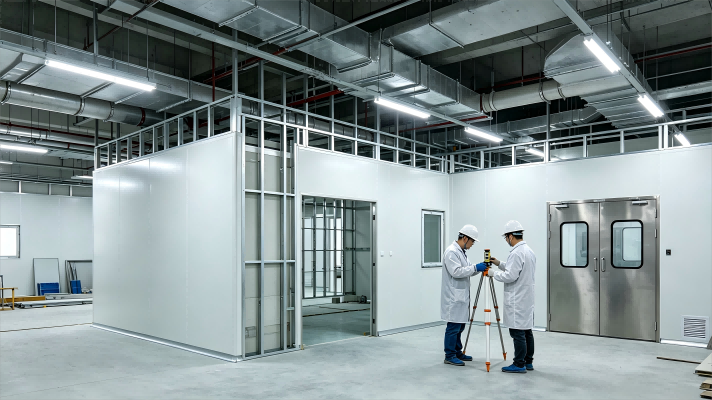
Selecting the wrong polymer for a cleanroom wipe or glove can quietly sabotage an entire manufacturing batch. Many materials shed invisible fibers or leave behind ionic residues that contaminate sensitive surfaces, even when they feel smooth to the touch. Overlooking how a substrate reacts with cleaning agents or process solvents is another common oversight: a material that appears durable may swell, crack, or release plasticizers under routine exposure, turning a supposedly clean tool into a source of airborne particles and chemical drift.
The static charge built up on synthetic surfaces often goes unnoticed until product defects appear. Materials with high triboelectric propensity attract and hold fine particulates, making it nearly impossible to wipe a surface truly clean. Similarly, outgassing from adhesives, seals, or newly installed flooring can introduce volatile organic compounds that interfere with photolithography or coating processes. These pitfalls are rarely obvious during initial qualification, but they accumulate over time, degrading yields and forcing costly revalidation of cleanroom protocols.
A practical way to avoid these traps is to treat material selection as an ongoing risk assessment rather than a one-time purchase decision. Request batch-specific test data for particle shedding, non-volatile residue, and chemical compatibility instead of relying on generic spec sheets. Observe how materials perform after repeated autoclaving or gamma irradiation, since degradation often appears only after multiple cycles. By anticipating how each material behaves under real process conditions, engineers can prevent small compromises from becoming systemic sources of contamination.
Getting HVAC and Filtration Right for Target Cleanliness Grades
Meeting a target cleanliness grade is less about adding more air and more about shaping what the air does once it enters the room. HVAC design has to hold the right pressure cascade, keep return paths short enough to avoid dead zones, and place terminal filtration where it can actually protect the critical zone. Without that, even a high air change rate can leave you with particle counts that drift out of spec.
Filtration choices follow the grade rather than a one-size-fits-all spec. Grades like ISO 7 or GMP C can often run on well-sealed H13 or H14 filters, while ISO 5 and GMP A/B demand ULPA or high-efficiency H14/ULPA combinations with proper gel-seal housings. Prefiltration matters just as much; a cheap prefilter that loads fast will force the final filter to work harder, shorten its life, and let more fine particles through when it gets damaged during changeouts.
What trips people up later is treating HVAC as a set-and-forget system. Recovery rate after door openings, pressure differential drift across adjacent zones, and filter media damage during maintenance all move the actual cleanliness away from the design point. A good commissioning plan pairs particle counts under dynamic conditions with simple ongoing checks—pressure alarms, airflow verification, and visual inspection of gaskets—so the room proves the grade instead of just claiming it on paper.
Using Pressure Differentials as an Invisible Contamination Barrier
Air doesn't need a visible wall to be directed—it simply follows the path of least resistance, moving from higher pressure to lower. By carefully adjusting supply and exhaust air volumes in adjacent rooms, a facility can create a subtle but persistent pressure gradient. When a cleanroom is kept at a slightly higher pressure than the corridor outside, any air that leaks around door seals or through small gaps flows outward. This outward flow carries dust, microbes, and other contaminants away from the critical area, forming an invisible barrier that works continuously without requiring anyone to close a physical door or wipe down a surface.
The direction of the pressure differential determines what gets protected. Positive-pressure rooms push air out, shielding products, patients, or sensitive processes from external contamination—think of an operating room or a pharmaceutical filling line. Negative-pressure rooms pull air in, keeping dangerous particles or pathogens from escaping into surrounding spaces. A tuberculosis isolation ward or a biosafety level 3 lab relies on this inward flow. Many facilities use cascading pressures across multiple zones: the cleanest area holds the highest pressure, with each surrounding zone slightly lower, so that air always moves from clean to less-clean without ever reversing course.
Maintaining a reliable pressure barrier demands more than just setting a fan speed once. Door undercuts, wall penetrations, and even the brief opening of a pass-through window can disrupt the balance. Modern systems use differential pressure sensors that feed real-time data to building automation controls, adjusting damper positions or fan speeds within seconds. Some designs add anterooms or airlocks as buffer zones, so that entering or exiting a critical space doesn't cause a sudden pressure collapse. When properly tuned, the pressure difference itself becomes a silent, always-on guardian—no moving parts in the doorway, just a steady flow of air doing the heavy lifting.
Documentation Tactics That Satisfy Auditors and Regulators
A documentation set that keeps auditors off your back rarely starts with perfect prose. It starts with an unbroken chain of evidence. Every change to a control, a procedure, or a system setting should tie back to a dated entry that shows who approved it, why it changed, and what testing followed. Auditors do not want narrative summaries; they want the raw trail. Keep version histories visible, attach approval emails or sign-off logs, and never let a file be overwritten without a record of the previous version.
Mapping documents directly to regulatory clauses cuts review time dramatically. Instead of organizing folders by department or year, build a matrix that pairs each requirement with the specific evidence that satisfies it. When a regulator asks about data retention, you should be able to point to the policy, the technical configuration screenshot, and the last three audit logs in under a minute. This kind of cross-reference feels mechanical to create, but it removes the most common friction point: the back-and-forth request for “just one more document.”
Finally, make the documentation boringly consistent. Use the same naming convention for every file, the same header block on every report, and the same location for every approval signature. Regulators pick up on gaps not because they are hunting for fraud, but because irregular formats slow down their review. A stable template, a clear owner listed on each document, and a quarterly refresh of stale links will often satisfy a review without a single clarification meeting.
Training Operators to Be the First Line of Defense
Operators rarely get credit for the incidents they prevent, but that silence is exactly what makes them valuable. A well-trained operator notices when a compressor's vibration signature shifts half a step before the alarm threshold trips, or when a contractor's badge swipe happens at an unusual hour. Training for that kind of awareness isn't about adding more checklists; it's about building a mental model of normal so the abnormal stands out. Simulations that introduce messy, low-signal anomalies—not just dramatic failures—help operators develop the instinct to investigate rather than dismiss.
The shift toward seeing operators as a defense layer also means giving them permission to act on uncertainty. Too many programs still treat "when in doubt, stop the job" as a slogan rather than a supported behavior. Organizations that pair scenario-based drills with clear escalation paths see fewer near-misses turn into production losses, because the operator feels equipped to pause a process and explain why. That confidence comes from repeated practice with feedback, not from a one-time safety briefing.
FAQ
Many teams fixate on air change rates while ignoring room layout and material flow. A common failure is placing the airlock or material pass-through in a way that forces personnel to cross from a Grade B area directly into Grade D without a proper transition. Under China GMP, the regulatory expectation focuses on contamination control logic, not just particle counts. So if a design allows a cart or person to move from a lower grade to a higher grade without staged gowning or decontamination, inspectors will flag it during review. Another frequent issue is underestimating the need for smooth, cleanable surfaces with no ledges or recesses that trap dust. The layout should be developed with the airflow visualization in mind, not just fitted around existing building columns.
ISO 14644 gives cleanroom classes based on airborne particle concentration, but China GMP adds a clear operational state: "at rest" and "in operation" limits for each grade, plus mandatory microbial limits. For example, Grade A requires not only ISO 5 particle levels but also <1 CFU/m3 settle plate and <1 CFU/m3 contact plate in operation. The standard also expects formal classification and continuous monitoring for Grade A zones, with alert and action limits tied to historical data. In short, China GMP demands a contamination control strategy that goes beyond static particle testing.
Surfaces must be smooth, non-shedding, resistant to cleaning agents and disinfectants, and installed with minimal joints or sealed joints. For walls and ceilings, polyurethane-coated sandwich panels or stainless steel are common; for floors, seamless epoxy or polyurethane with coved intersections to the walls. Avoid vinyl tile or any material that can crack or harbor microorganisms. Joints should be sealed with flexible, non-porous sealant, and all penetrations for utilities need to be fully gasketed. The key is that no surface can become a source of particles or microbial growth under routine cleaning and disinfection.
The pressure cascade must protect the most critical zones, typically Grade A, from lower-grade areas. Aim for at least 10-15 Pa positive pressure between adjacent grades, with a clear pressure differential map. But static pressure alone is not enough—inspectors will ask for airflow visualization and recovery tests showing the air moves from cleaner to less clean areas even with doors briefly open. Filter placement, return air locations, and supply air diffusers need to create a unidirectional flow in critical zones. Also, consider a minimum air change rate that supports both particle removal and microbial control, not just the theoretical ISO class. Commissioning should verify that pressure drops across terminal HEPA filters are within design limits and that alarm systems trigger when pressure deviates.
Particle counts can be temporarily improved by over-filtering or high air changes, but if the cleanroom was not properly commissioned—meaning HVAC balancing, leak testing of filters, airflow visualization, and pressure differentials were not done in the right order—the system may fail under actual production loads. China GMP requires a logical sequence: design qualification (DQ), installation qualification (IQ), operational qualification (OQ), and performance qualification (PQ). Rushing to PQ before OQ is complete often leads to hidden defects like incorrect duct slope for drainage, poor filter sealing, or failure of interlock systems. A clean particle count at rest does not prove that dynamic conditions with personnel and equipment will remain compliant.
Missing or incomplete traceability between URS, DQ, IQ, OQ, and PQ is the biggest pitfall. Many projects have final reports but cannot show how each user requirement was verified. Other common issues include not documenting the rationale for sampling locations for environmental monitoring, failing to record raw data for particle counters instead of only summary values, and not linking alarm events to corrective actions. Also, training records for operators and maintenance staff must show competence in cleanroom behavior. Chinese inspectors place heavy emphasis on data integrity, so any sign of discarding out-of-spec results or altering timestamps will trigger a major finding.
The most effective approach is to reduce airflow where the process allows without compromising contamination control. This can be done by using variable air volume (VAV) systems that lower air change rates during non-production hours while maintaining positive pressure. Another method is to carefully size HVAC equipment based on actual heat load and particle generation, not over-designing with excessive safety factors. Energy recovery systems on exhaust air, high-efficiency fans, and demand-controlled filtration can also cut costs. However, any energy-saving measure must be validated to show that during production the cleanroom still meets its Grade A/B/C/D limits. Presenting a clear engineering justification in the risk assessment helps avoid inspector pushback.
Ongoing monitoring is not just a regulatory formality—it is the only way to show that the cleanroom remains in a state of control over time. China GMP expects a risk-based monitoring program that includes airborne particles, viable monitoring (settle plates, contact plates, and active air sampling), surface sampling, and pressure differential monitoring. Alert and action limits should be derived from historical data and reviewed periodically. The data must be trended to detect gradual shifts, such as filter loading or operator behavioral drift, before they become excursions. If a company treats monitoring as a check-box exercise and never acts on trends, inspectors will see the cleanroom as only qualified at a single point in time, not truly compliant.
Conclusion
Cleanroom construction under China's Good Manufacturing Practice guidelines rarely fails because of a single glaring error; instead, it unravels through small, compounding choices that begin long before a single wall goes up. Layout decisions set the stage—every corridor, airlock, and pass-through must support unidirectional flow of personnel, materials, and waste, because a poorly placed gowning room or a dead-end corridor can create cross-contamination risks that no amount of filtration can undo later. Equally important are the materials chosen for floors, walls, and ceilings. In many Chinese facilities, humidity and aggressive cleaning agents accelerate degradation, so surfaces need to be non-shedding, chemical-resistant, and free of crevices where microbes can hide. Once the shell is right, HVAC and filtration demand exacting attention: air change rates, HEPA placement, and temperature/humidity stability must be matched to the target cleanliness grade, not copied from a template. The real, invisible guardrail is pressure differential—maintaining a cascade of positive pressure from critical zones to less clean areas means doors, dampers, and monitoring systems have to be commissioned and challenged repeatedly, not just set once.
Documentation is where many cleanrooms quietly fail an audit. Instead of treating records as an afterthought, leading projects integrate design qualification, installation verification, and operational protocols into the construction timeline so that every material certificate, weld map, and filter test result traces back to a specific room and system. China's inspectors often probe the gap between what the drawing claims and what the building actually delivers, so as-built documents, risk assessments, and deviation logs need to be updated in real time, not reconstructed before an inspection. Finally, no physical barrier works without trained operators. Gowning technique, movement discipline, and response to pressure alarms must be drilled until they become instinctive, because a single person touching a face mask or propping open a door can compromise the entire facility. The best GMP cleanrooms in China treat operators as part of the contamination control system, with regular observation, retraining, and a culture that rewards reporting small anomalies before they become batch failures.
Contact Us
Contact Person: Amy Yang
Email: [email protected]
Tel/WhatsApp: 008619330882686
Website: https://www.genopharmatech.com/