China Pallet Rack Company Delivers Durable Industrial Storage Racking Solutions
2026-11-16
When warehouse managers talk about the real bottlenecks in daily operations, racking rarely makes the headlines—until a beam fails. Lanyuda, a China pallet rack company known for durable industrial storage racking solutions, has been quietly changing that narrative. Here's a look at what separates dependable racking from costly compromises, and why more facilities are turning to Lanyuda's engineered approach.
Frames That Don't Flinch When Forklifts Hit
Most steel guards bend on the first real hit, and that's where the hidden costs start. These frames take a different route: reinforced gussets at every stress joint, thick base plates, and weld seams placed away from the line of impact. When a forklift clips one at speed, the usual outcome is a scuff you can paint over, not a twisted section that has to be cut out and replaced.
Warehouse crews who work around these frames say the difference shows after a few months. Corners are radiused to turn fork tips instead of catching them, and the anchors hold without ripping loose from the slab. Even if the paint wears thin, the frame underneath stays square and ready. It's the kind of durability that comes from building for the worst hit, not the average one.
Custom Rack Dimensions Without the Custom Quote Delays
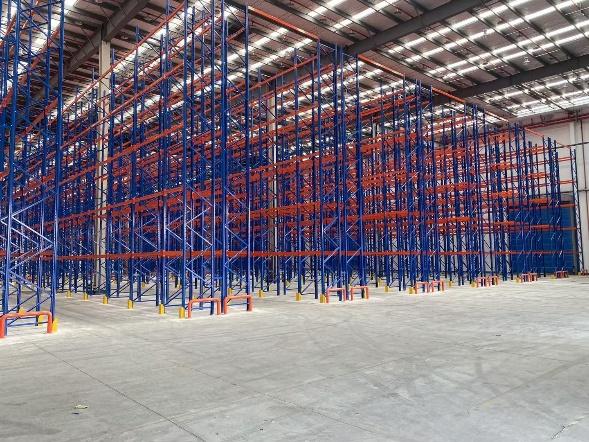
Getting a rack that actually fits your space shouldn't mean waiting weeks for a sales rep to get back to you. Our ordering system is built around real-time dimensional inputs, so you can specify width, depth, height, and even mounting hole spacing on the spot. The configurator shows an immediate drawing and price, which keeps lead times in days rather than quote cycles.
Because the engineering tolerances and material options are already dialed in, there's no back-and-forth over drawings or feasibility. Whether you're replacing a legacy enclosure or squeezing hardware into an unusual corner, you can lock in odd sizes without the usual custom-order premium. The result is a rack that arrives ready to install, not a pile of parts waiting for a project manager's approval.
The Coating Difference: Why Our Racks Resist Rust Longer
Most racks start to show rust at the welds and cut edges within a year or two. Ours don't, because the coating isn't just sprayed on top—it's bonded into the steel. Before any color goes on, every frame runs through a seven-stage wash that removes mill scale and etches the surface at a microscopic level. That gives the first layer something to bite into, rather than just sitting on the metal.
From there, we apply a zinc-rich base coat that acts as a sacrificial layer. If the topcoat ever gets scratched, the zinc corrodes first, keeping the steel underneath intact. It's the same principle used on marine equipment, but scaled for warehouse shelving. On top of that, a polyester powder coat is baked on at 200°C, forming a hard shell that resists chips, UV fading, and chemical spills.
The result is a rack that survives damp basements, unheated garages, and washdown areas without the orange streaks you see on cheaper units. We regularly pull samples from production and run them through 1,000-hour salt spray tests, and the finish holds. That's why the coating difference isn't just a sales claim—it shows up years later when your shelves still look clean and your inventory stays dry.
How We Reinforce Beams for Multi-Ton Loads
Most multi-ton failures trace back to deflection or localized buckling rather than a clean snap. We start by measuring the existing beam under its current dead load, then map where the new concentrated forces will enter. If the web is tall and slender, stiffener plates get welded at each bearing point before any flange work. This preloading of the connection zone prevents the kind of progressive crippling that shows up later as cracked welds.
For beams with adequate web but weak flanges, a bolted cover plate works faster than field welding and avoids heat distortion on loaded members. We cut the plate slightly narrow of the flange edges, bevel the ends, and stagger the bolt pattern so the first row of fasteners never lines up with a stress riser. Temporary shoring carries the load while the new steel is fitted, and we tighten bolts from the center outward in two passes to get uniform bearing.
After reinforcement, we don't trust visual inspection alone. Dial indicators or wireless strain gauges get placed at mid-span and over each new stiffener. A controlled load test is run in increments, with readings taken at every step. If the deflection curve stops being linear before design load, we stop and check the bolt torque and weld profile. This catches loose connections and undersized plates early, when they are cheap to fix.
Cold Storage, High Humidity, and Still No Corrosion
Cold storage rooms are notorious for sweating pipes, dripping ceilings, and metal that turns brown within months. Yet there are facilities where the racking, door frames, and evaporator housings look just as clean after five years as they did on day one. The secret isn't a miracle alloy—it's a deliberate mix of the right coating, proper surface prep, and a few overlooked maintenance habits that keep moisture from ever gaining a foothold.
Most standard paints fail in these conditions because they're applied to metal that's already cold, causing the film to cure unevenly. Specialized cold-curing epoxies and moisture-tolerant primers fix that problem by bonding at temperatures just above freezing, staying flexible enough to move with the metal as it contracts. Topcoats with a high cross-link density then seal out the thin film of condensation that forms every time a door opens and warm air rushes in.
Perhaps the biggest difference comes from simple housekeeping. Draining drip trays, repairing door seals, and touching up scratches before rust can start are routines that take minutes but save years of surface life. When all of that is in place, a high-humidity cold store stops being a corrosion trap and starts behaving like any other well-kept room.
What Your Warehouse Manager Should Expect During Installation
Warehouse managers rarely worry about the equipment itself; they worry about losing a shift. During installation, expect the vendor crew to arrive with a printed site plan and walk the floor before unboxing anything. That initial walkthrough should settle dock positions, rack clearances, and staging zones—not just assume the drawings match the forklift paths.
The first day usually brings disruptions in receiving and putaway. A good installer will phase the work by aisle instead of scattering tools across the floor. Your manager should insist on a daily cutover time, usually 30 minutes before the second shift, so any unfinished cabling or panel work is either made safe or roped off. Wiring and sensor calibration will take longer than the sales quote suggests if the floor is older or if conveyors have been re-laid multiple times.
Near the end, expect a dry run without live inventory. This is the moment to test barcode reads at speed, divert logic, and stop/start cycles with real cartons. If the installer wants to train only one super-user, push back. Have at least two people on each shift walk the new stations while the technicians are still on site. After sign-off, request a handover packet with panel schedules, sensor placement notes, and torque settings, not just a vendor manual.
FAQ
They focus on pallet racking systems, including selective racks, drive-in racks, and push-back racks, built to handle heavy loads in warehouses and distribution centers.
They use high-strength steel with powder-coated or galvanized finishes, and each component undergoes load testing and quality checks before shipping.
Yes, they offer custom engineering to accommodate different ceiling heights, aisle widths, and load capacities, so the system fits your space instead of forcing a standard layout.
You'll find their racks in manufacturing, cold storage, retail backrooms, e-commerce fulfillment centers, and automotive parts warehouses.
They supply detailed assembly manuals and can arrange on-site installation supervisors or full installation teams depending on project size.
Yes, their products are designed to meet or exceed standards such as AS4084, RMI, and FEM, and they provide load capacity documentation with each order.
Standard components usually ship within 15-25 days, while heavily customized projects may take 30-45 days depending on quantity and finish requirements.
They have experience with container loading, export packing, and coordinating with freight forwarders to get racks delivered safely to ports worldwide.
Conclusion
The racks from this China-based supplier hold up when forklifts miss their mark—frames are built with reinforced steel and upright protectors that shrug off routine impacts instead of twisting or buckling. Beyond toughness, the company handles size variations on the fly: you give the bay width and load height, and the fabrication team adjusts dimensions without dragging you through weeks of quote revisions or extra charges. The finish is another point of difference. A multi-layer zinc-infused primer followed by a baked-on topcoat, not just a quick powder dip, means rust stays away longer even in damp corners of the warehouse. That kind of durability is what keeps racking in service past the first dent.
Load-bearing beams get extra attention, with internal stiffeners and welded gussets that let a single bay carry multi-ton pallets without sagging. That same corrosion resistance carries into cold storage and high-humidity rooms, where ordinary racks start showing red streaks within a season. During installation, the crew arrives with pre-cut components and clear layout drawings, so your warehouse manager can expect a predictable schedule, minimal disruption to daily picking, and a full walk-through before sign-off. No surprises, no hidden delays. It's storage racking that earns its keep long after the first hit.
Contact Us
Contact Person: Johnny
Email: [email protected]
Tel/WhatsApp: +86 18151010686
Website: https://lydstorage.com