

Dry-Type Transformer Factory: Inside the Manufacturing Process and Quality Control
2026-08-18
Dry-type transformers are the quiet workhorses of electrical distribution, but their reliability hinges on what happens inside the factory. At Chang Song, the manufacturing process is a tightly controlled journey from raw materials to final testing—where every weld, winding, and insulation layer is scrutinized. In this post, we’ll walk you through that journey, revealing the quality control measures that separate a good transformer from a great one.
How Core Laminations Are Cut and Stacked for Minimal Magnetic Losses
The raw strip arrives with a thin insulating coating already applied, and the first thing that matters is how it gets separated. Laser cutting leaves a narrow heat-affected zone that can degrade domain alignment, so many shops still prefer high-speed mechanical punching with sharp tooling. The burr height gets checked under a microscope because even a 20-micron ridge will bridge adjacent laminations at the edges.
Stacking for minimal loss is less about perfect alignment and more about breaking up the magnetic circuit. Rotating each layer by 180 degrees evens out thickness variations and prevents the bolt holes from creating a low-reluctance shortcut. Step-lap joints at the corners, where the lamination offsets by a few millimeters per layer, spread the flux transition across a larger area instead of forcing it through a single butt joint.
Once stacked, the core often goes through a low-temperature anneal to relieve cutting stress, though the interlaminar insulation has to survive that cycle. The final clamping pressure is set low enough to avoid micro-deformation of the steel surface but high enough to keep the stack mechanically stable under vibration.
Winding Methods That Keep Hotspots Out of Dry-Type Coils
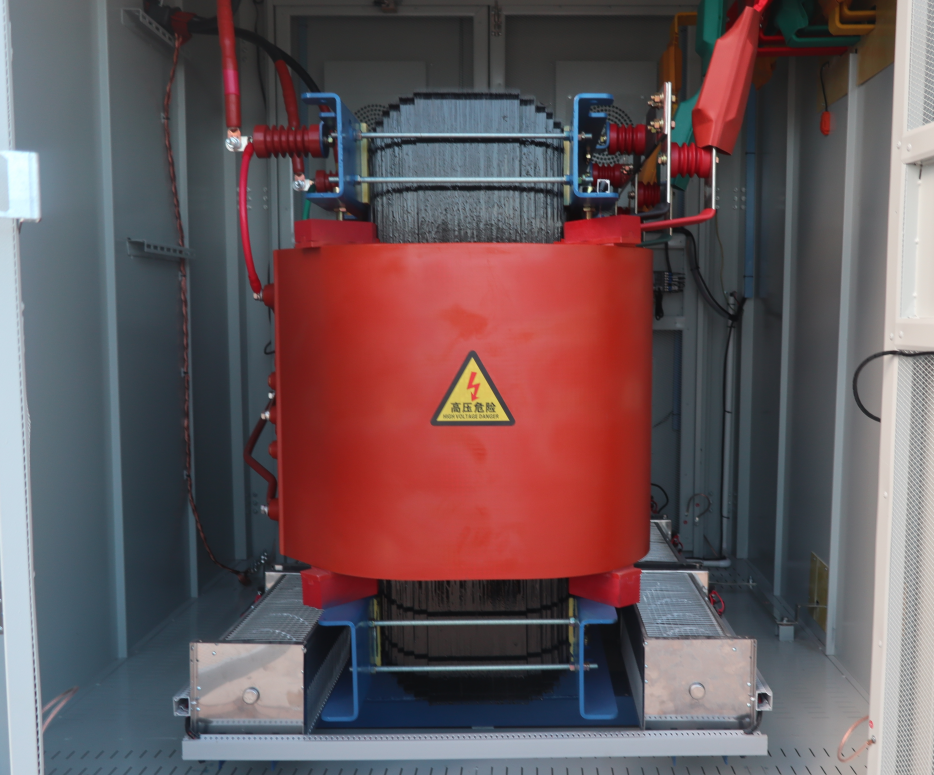
Dry-type coils run into trouble when a few turns carry more current than their neighbors, or when local insulation thickness blocks heat from escaping. One approach that sidesteps this is precision layer winding with controlled conductor spacing: by holding tension within a narrow band and placing turn-to-turn gaps based on the voltage gradient, the winding pack stays uniform enough that no single area becomes a thermal bottleneck. Slight adjustments to spacing near the core edges also help, because that is where stray flux tends to concentrate and raise eddy losses.
Another route uses transposed conductors or continuously interleaved disks. Transposition forces each strand to occupy different radial positions, equalizing resistance and circulating-current losses that would otherwise create internal hot zones. In disk-type coils, interleaving the turns changes the series capacitance distribution, which lowers the voltage stress at the line end and prevents dielectric heating from sneaking up under impulse conditions. It is a more labor-intensive build, but the temperature map evens out noticeably.
Finally, practical details matter as much as the winding pattern. Ducts placed perpendicular to the heat path, rounded conductor edges, and vacuum-pressure impregnation all reduce local thermal resistance. In foil-wound low-voltage sections, the foil width itself acts as a heat spreader, pulling energy away from the center and toward the outer cooling surfaces. These methods work best when the winding designer accounts for actual airflow direction rather than assuming uniform cooling around the coil.
Vacuum Pressure Impregnation: Why It Decides Coil Lifespan
The quiet failure of an electric motor rarely starts with the bearings or the shaft. It begins inside the windings, where microscopic voids between copper strands invite moisture, dust, and partial discharge. Vacuum pressure impregnation (VPI) exists to eliminate those voids — but how well it does that job directly determines whether a coil lasts five years or twenty. The process seems straightforward: pull a vacuum to draw out trapped air and moisture, then push insulating resin deep into every crevice under pressure. Yet the difference between a superficial dip-and-bake and a true VPI cycle is where coil lifespan is won or lost.
Without proper impregnation, coils are vulnerable to vibration-induced abrasion. When current flows, electromagnetic forces cause conductors to flex microscopically. If resin hasn’t bonded the strands into a solid mass, they rub against each other, wearing through enamel insulation. That creates hot spots and eventually turn-to-turn shorts. VPI changes the mechanical dynamic entirely — the cured resin locks every conductor in place, turning a bundle of loose wires into a rigid, monolithic structure. This mechanical stabilization is often overlooked, but it’s one of the strongest predictors of how long a coil survives in a high-vibration environment.
Then there’s the thermal pathway. Air is a terrible conductor of heat, and any unfilled gap inside a coil acts as an insulating barrier that traps heat right where it’s generated. VPI replaces air with resin, which has far better thermal conductivity. That means lower hot-spot temperatures for the same load, and since insulation aging roughly doubles with every 10°C rise, even a 5°C reduction can dramatically extend coil life. In practice, well-impregnated coils run cooler at the same output, and those extra degrees of margin are often the difference between a planned rebuild cycle and an unplanned outage.
Automated Assembly Lines and the Human Checks That Still Matter
Walk into any modern factory and you'll see robots welding, sorting, and moving parts with a precision that makes human hands look clumsy. Automated assembly lines have transformed manufacturing, squeezing out seconds and cents from every cycle. Yet even the most advanced vision systems and torque sensors can't fully replace a person who has spent years learning the subtle sound of a misaligned gear or the faint smell of overheated lubricant. These human checks aren't leftovers from a bygone era; they're the difference between a product that meets spec on paper and one that actually works in the real world.
Consider a line producing electric power steering units. The robot presses bearings into housings and laser-welds seams, while an algorithm monitors force curves for anomalies. But when a batch of housings arrives with slightly different surface roughness—something no specification sheet flagged—the algorithm stays quiet. The veteran operator, though, notices a tiny change in the vibration pattern through the floor. She stops the line, runs a finger along a finished unit, and finds a burr no camera caught. That moment of judgment, built from thousands of hours of tactile feedback, remains stubbornly hard to automate.
The real challenge isn't deciding whether humans or machines should do the checking—it's designing the flow so they complement each other. Automated systems can tirelessly inspect every unit, flagging deviations from a statistical norm. Human inspectors, freed from repetitive pass/fail tasks, can then investigate those flags, drawing on context a machine lacks: a supplier's recent change, an unusual weather pattern, or a tool that's nearing end of life. When a factory respects both the consistency of automation and the adaptive reasoning of experienced workers, it stops chasing zero defects and starts building genuine reliability.
Routine Tests That Go Beyond Nameplate Ratings
A nameplate gives you rated voltage, current, and horsepower, but the real assurance comes from tests that never appear on that metal tag. In most production facilities, every motor or transformer leaving the floor is subjected to winding resistance checks, insulation resistance measurements, polarization index readings, and high-potential withstand tests. These go looking for turn-to-turn weaknesses, moisture that crept into windings, or a core that wasn’t assembled quite right—problems a simple spec sheet will not reveal.
Thermal performance is another area where routine testing extends well past the engraved numbers. Full-load heat runs, sometimes paired with locked-rotor or stalled conditions, map hot spots that would never show up in a standard efficiency figure. Vibration data collected at several load steps can expose bearing defects, rotor imbalance, or structural resonance that might otherwise sail through a basic nameplate speed check.
Many shops also include no-load and locked-rotor tests, along with surge comparison testing, to compare every unit against a known baseline waveform. That kind of routine protocol catches material or workmanship drift that a final glance at the rating plate would miss. The end result is a machine that doesn’t just meet its advertised ratings but is far more likely to hold up under the stresses those numbers imply.
Final Inspection: The Last Barriers Before Shipping
The final check before shipping is not a formality; it is the last chance to catch defects that would otherwise lead to a customer return. Each product goes through a quick but unforgiving pass: the outer casing is checked for hairline scratches, every screw is confirmed tight, accessories are counted against the packing list, and the function keys are pressed to verify the expected feedback. For units with seals or glass components, this stage is especially merciless—any visible flaw means the item is pulled for rework or the whole batch is quarantined.
Beyond the product itself, packaging durability is often the most underestimated part of final inspection. A unit can pass every performance test, but if the moisture barrier bag is not heat-sealed completely or the foam inserts shift during transit, the customer receives a damaged first impression. Inspectors check the outer carton’s stacking strength, the density of cushioning material, and whether the shipping label matches the order number. They also perform simple drop or shake tests. Only when the packaging proves as tough as the product does the dispatch note get signed.
Recording the defects that are stopped at final inspection—by type and by frequency—reveals more about the production line than any daily report. If the same flaw appears in the same location for three consecutive days, it is not an operator’s mistake but a sign that a fixture or parameter has drifted. A mature team does not treat final inspection as the end of the line; it treats it as the most direct form of process audit, where every interception tells the upstream process where to tighten control.
FAQ
Most manufacturers rely on copper or aluminum conductors, but the insulation system is what really sets designs apart. For example, many factories use Nomex or polyimide film between layers, combined with epoxy resin vacuum impregnation to lock everything in place and keep moisture out.
The core is usually built from grain-oriented silicon steel laminations, cut and stacked to minimize losses. A good factory will step-lap the joints rather than butt them, which reduces no-load losses and noise. Poor core alignment can ruin efficiency even if the windings are perfect.
VPI is a critical step for many dry-type transformers. The wound coils are placed in a vacuum chamber to remove air and moisture, then flooded with varnish or resin under pressure. This fills every void in the insulation, improving dielectric strength, thermal conductivity, and resistance to humidity and contaminants.
Each unit usually goes through routine tests: winding resistance, turns ratio, insulation resistance, dielectric withstand, and induced voltage tests. The factory may also run a partial discharge test to detect tiny voids in the insulation that could lead to failure later. Load loss and temperature rise tests are often done on prototypes or sample units.
Since there is no liquid coolant, dry-type transformers rely on air circulation. Factories often use ventilated enclosures, air ducts between coils, or cast resin designs that allow natural convection. Some larger units include forced-air cooling fans that kick in based on winding temperature sensors.
Humidity control is huge because moisture can degrade insulation before impregnation. Many factories keep winding and assembly areas at low relative humidity, sometimes below 50%, and use dust-free rooms for high-voltage coil winding. Cleanliness prevents conductive particles from getting trapped in the insulation.
Yes, cast resin transformers embed the windings in epoxy under vacuum, which creates a solid, maintenance-free block that is very robust against moisture and chemicals. VPI transformers use a more traditional varnish treatment, which is less rigid and can be easier to repair or rewind. Each process has its own tooling and curing cycles.
Operators check conductor dimensions, insulation layers, and winding tension during setup. After each coil is wound, it may be measured for resistance and inductance before being connected. Core stacking is inspected for gaps or burrs, and final assembly includes torque checks on all electrical connections to avoid hot spots.
Conclusion
Walking through a dry-type transformer factory, the first thing you notice is how core laminations are cut and stacked with almost obsessive precision. The goal isn't just to build a core; it's to keep magnetic losses as low as possible, so each thin sheet is handled, aligned, and clamped to avoid burrs and gaps that would otherwise heat up under load. Nearby, winding stations operate with a similar quiet discipline. Coil winding methods here are designed to spread electrical stress evenly, preventing hotspots from forming in dry-type coils that lack oil for cooling. Then comes vacuum pressure impregnation, the step that often decides how long a coil will live. Drawing resin deep into every winding gap under vacuum and pressure locks out moisture and contaminants, giving the coil its mechanical strength and insulation integrity.
Further down the line, automated assembly lines move parts with speed, but the human checks still matter in ways machines can't fully replace. An experienced eye catches a slightly off-center bus bar or a torque pattern that feels wrong. Routine tests go beyond nameplate ratings, probing insulation resistance, induced voltage, and temperature rise in ways that reveal weaknesses a simple label would never show. Before anything leaves the floor, final inspection acts as the last barrier before shipping: dimensions are verified, connections torqued, and surfaces checked one more time. Together, these stages turn raw steel, copper, and resin into a dry-type transformer built to run for decades without oil, quietly and safely.
Contact Us
Contact Person: Tonglun Chen
Email: [email protected]
Tel/WhatsApp: 8618906642555
Website: https://www.cncsele.com