High Speed Diaper Machinery Transforms Manufacturing Efficiency
2026-11-02
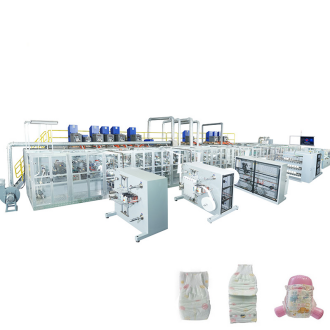
Ask any plant manager what keeps them up at night, and line speed usually tops the list. High speed diaper machinery has changed that conversation entirely. Modern systems now hit output levels that were unthinkable a decade ago, while cutting material waste and downtime. Womeng has been quietly pushing these boundaries, helping manufacturers turn efficiency from a goal into a daily reality. Here's a closer look at what's driving the shift.
Faster Throughput Starts Before the Machine Does
Production managers often chase higher speeds by tweaking machine parameters, but the biggest gains usually hide in the minutes before startup. A well-staged work area, pre-loaded tools, and clear job instructions let operators move from one task to the next without hesitation. When materials are kitted and checked ahead of time, the machine spends its energy cutting, forming, or assembling rather than waiting for someone to find the right fixture.
Shift handovers also play a quiet but powerful role. If the next crew arrives to a clean, organized station with accurate notes on what ran well and what didn't, they can reach stable output much faster. Simple routines like verifying coolant levels, tightening gages, and walking through the first-part checklist before the cycle starts prevent mid-run interruptions that quietly eat capacity.
Where Traditional Lines Hit Their Ceiling
Most pricing strategies assume a straight path from cost to value, but that line breaks the moment customers compare more than price tags. The old playbook of margin stacking, competitor matching, and seasonal discounts starts to wobble when buyers weigh total ownership, switching effort, and trust in the same breath. What used to feel like a clean equation becomes a mess of intangibles that no spreadsheet can fully capture.
Traditional models also lean hard on historical data, as if yesterday's demand curve will politely repeat itself. Yet markets now shift faster than quarterly reports can land. A competitor launches a bundled service, a supply snag reshapes availability, or a social trend flips perceived value overnight. Relying on fixed tiers and rigid discount ladders leaves teams reacting instead of steering, and the ceiling isn't just a metaphor—it's the point where every old lever returns less than the effort put in.
Perhaps the trickiest limit is how those lines treat customers as uniform points on a graph. Real buying groups have mixed priorities: some chase durability, others convenience, and a few quietly value the brand story more than the spec sheet. When pricing can't flex around those differences without breaking internal logic, it stops being a tool for growth and becomes a cage built from its own assumptions.
Why Changeover Time Matters More Than Top Speed
Raw speed only wins if you can stay on track. In most real production environments, the gap between cycles isn't neutral — it's where defects hide, temperatures drift, and material handling eats the margin you thought you saved by sprinting. A process that runs flat out but needs forty minutes to switch from one SKU to another will lose more weekly output than a slightly slower line that swaps over in eight minutes.
Consider a packaging hall running three product sizes. The fastest filler on the market might hit 600 units per minute, but if each format change costs 45 minutes of downtime, two changeovers per shift eat 90 minutes. A filler rated at 520 units per minute with a 10-minute changeover produces more salable units across a mixed schedule — not because it's quicker, but because it spends less time doing nothing useful. Over a month, that difference compounds into whole extra shifts of productive time.
The same logic applies beyond machinery. Pit crews obsess over tire swaps because a car can't score points while stationary. Kitchens redesign stations around the pass because the moment between orders determines table turns. Once you stop treating changeover as a pause and start treating it as part of the cycle, top speed becomes a secondary number — useful only after you've stopped leaking time between the runs that actually pay.
Engineering Out the Small Stops
Small stops are the quiet productivity killers on any line. They rarely last more than a few seconds—a part jams, a sensor misfires, an operator nudges a misaligned tray—but over a shift they can steal hours. The instinct is to treat them as normal flickers of production, yet that acceptance is exactly what lets them persist. Engineering them out starts with refusing to call them minor.
The core approach is to watch the line not as a manager but as a detective. Film the work, log every interruption with a stopwatch, and group the causes into patterns: is the conveyor slipping, the fixture wearing, the pick-and-place missing due to vibration? Once you see the mechanism behind each few-second stop, you can redesign the element—a chamfer here, a stronger clamp there, a sensor repositioned to a cleaner signal path. The goal isn't faster operators; it's making the equipment so tolerant that the stop simply can't happen.
This mindset shifts maintenance from fixing breakdowns to preventing the tiny hesitations that precede them. Teams that keep a running small stop board and tackle one root cause every week find that line speed improves without adding labor or capital. It's unglamorous work, but the cumulative effect is a line that runs with the rhythm of a metronome rather than a stutter.
The Labor Equation Shifts When Machines Run Faster
When automation accelerates beyond a certain threshold, the old assumption that machines simply replace routine tasks starts to break down. A machine that can complete a process in half the time doesn't just displace one worker—it reshapes the entire rhythm of production. The labor equation no longer balances on headcount alone; it now factors in the tempo of work, the cost of idle hours, and the shifting threshold where human intervention becomes a bottleneck rather than a safeguard.
Faster machines create a curious inversion: instead of reducing labor inputs uniformly, they often increase the demand for oversight, maintenance, and rapid troubleshooting. A production line that once required ten operators for a single shift may now need only three, but those three must respond to anomalies within seconds, not minutes. The skill premium moves away from repetitive dexterity and toward pattern recognition under time pressure. Consequently, wages for these hyper-alert roles rise even as total employment in the sector falls.
The real shift, however, occurs at the level of scheduling and workflow design. When machine speed outpaces human reaction time, managers must decide whether to slow the equipment to match human cognition or to restructure the labor force into smaller, more specialized tiers. Some factories run machines at full velocity during off-peak hours with minimal staffing, then throttle down during periods requiring complex adjustments. This negotiates a new kind of equilibrium: not simply fewer workers, but a different distribution of attention, fatigue, and responsibility across the hours of operation.
Quality Checks That Keep Pace with Output
At the point where parts move faster than a human eye can follow, traditional sampling just leaves gaps. A camera mounted above the conveyor catches misaligned seals or rough edges the moment they appear, flagging them before they reach packing. That shift from end-of-line checks to real-time observation is what keeps reject piles small.
But speed alone creates noise. A sensor that triggers on every minor variation buries operators in false alarms, and they start ignoring it. Effective systems pair the immediate flag with a short context: which station produced the part, what the last three readings were, and whether the deviation matches a known pattern. This turns an alert into a decision, not a distraction.
The final piece is calibration rhythm. If the measurement tools drift between shifts, all that real-time data becomes fiction. Teams that spend ten minutes verifying gauges at shift handoff catch drift before it distorts trends. The output stays high, but the quality checks no longer lag behind it; they move with the line.
FAQ
The biggest difference comes down to cycle time and automation. Modern high speed machines can run hundreds of diapers per minute while automatically handling splicing, tension control, and defect rejection, which older equipment simply cannot sustain without frequent stops.
Yes, but not immediately. The upfront investment is significant, yet the cost per diaper drops noticeably because you spread labor, energy, and facility overhead across far more units. Waste reduction and fewer changeovers also contribute to long term savings.
Keeping material tension stable and maintaining precise cut registration become much harder as speed increases. Sensors and servo drives have to react in milliseconds, and any small misalignment can turn into a pile of defective products very quickly.
They can, but only if the quality control system is designed for that speed. Many newer machines use high resolution cameras and real time data to catch flaws while the line is running, so quality does not have to be sacrificed for speed.
They should look at current order volume, available floor space, raw material supply reliability, and whether their maintenance team can handle more complex equipment. Training operators for high speed troubleshooting is just as important as the machine itself.
It minimizes waste by using precise servo driven cutting and automatic web guiding, which reduce off cuts and misaligned layers. Faster startups and automated splicing also mean less material is thrown away during ramp up and roll changes.
Not necessarily. While large manufacturers benefit most from sheer volume, mid sized companies can justify the investment if they run long production batches. The key is matching machine speed to real demand rather than buying the fastest option available.
These machines need more frequent preventive maintenance than slower lines. Daily checks of blades, belts, and sensors are common, and many plants schedule weekly deep inspections to avoid sudden breakdowns that stop a high output line.
Conclusion
High speed diaper lines rarely deliver their rated output unless the entire production sequence is aligned before startup. Raw material tension, splice reliability, and core placement all influence whether a machine can actually sustain its advertised pace, and many converters discover that the bottleneck sits outside the press itself. Traditional lines tend to plateau once mechanical speeds climb, because every slight misalignment or web flutter turns into a stop that erases the gains from faster cycling. Changeover time often outweighs top speed in real factories; a line that can switch between sizes in under ten minutes will outperform a faster machine that takes an hour to reset. The new generation of equipment attacks these small stops with servo-driven corrections and predictive wear monitoring, so operators spend fewer shifts chasing intermittent faults.
As throughput increases, the labor equation changes. Fewer people are needed for manual handling, but the remaining technicians must interpret real-time data and respond to early warnings rather than react to breakdowns. Quality checks have also shifted from periodic sampling to continuous vision and ultrasonic inspection, which keeps pace with output without adding a separate inspection station. Together, these changes mean high speed diaper machinery improves efficiency not by simply running faster, but by making every minute of runtime count.
Contact Us
Contact Person: Jessie Lai
Email: [email protected]
Tel/WhatsApp: 86-188594442931
Website: https://www.wm-machinery.com