

Horizontal Concealed Fan Coil Unit Manufacturer: Choosing the Right Partner for Quiet, Efficient Climate Control
2026-11-02
Quiet comfort often hides in plain sight—above the ceiling, tucked away, working without a whisper. But not all horizontal concealed fan coil units are created equal, and the manufacturer you choose can make or break both acoustic performance and energy efficiency. Whether you're specifying for a hotel, office, or high-end residence, the wrong partner leaves you with noise complaints and costly retrofits. shairko approaches this challenge differently, combining precision engineering with a focus on real-world installation constraints. In this post, we'll unpack what separates a reliable manufacturer from the rest and why that hidden unit deserves more attention than it usually gets.
What Separates a Truly Quiet Horizontal Concealed Fan Coil from the Rest?
Most of the racket blamed on fan coils actually comes from airflow, not the motor itself. In the quietest horizontal concealed units, an electronically commutated motor holds a near-constant torque curve while a dynamically balanced, double-inlet impeller works at the lower end of its pressure range. That combination lets the unit move air through tight duct runs without the surge-and-hum you get from cheap PSC motors, and factory run-test data at 50, 100, and 150 Pa usually shows a 4–7 dB(A) gap between average and genuinely quiet models.
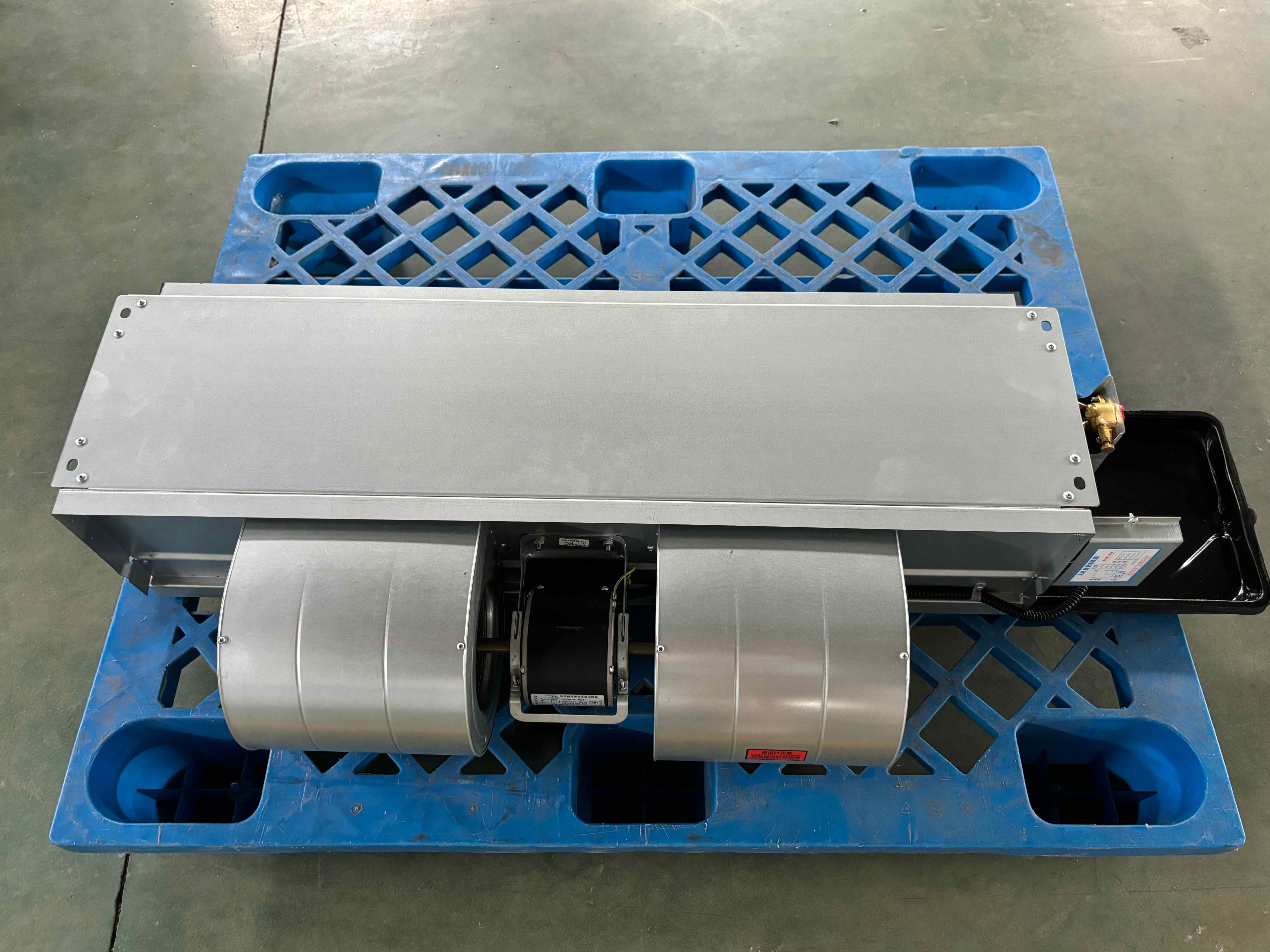
Cabinet design plays a bigger role than insulation thickness. A well-built concealed fan coil uses closed-cell acoustic foam that won't absorb moisture, a motor plate isolated on rubber grommets, and a condensate pan with a slight slope so water never pools and amplifies vibration. Double-wall panels with a viscoelastic damping layer cut low-frequency rumble, while rounded discharge openings reduce turbulence where air exits the cabinet. Cheap units often skip these details, then mask the problem with bulky external attenuators.
Finally, the quietest unit is only as quiet as its controls allow. Look for a controller that ramps fan speed gradually, supports a true 24/7 low-speed setting, and works with proportional valves instead of forcing the fan into stop-start cycles. Field adjustments should let you cap the maximum speed per room without guesswork. In practice, a correctly commissioned horizontal concealed fan coil can hold 25–30 dB(A) in a bedroom, while a poorly tuned unit with the same label will hover closer to 45.
Reading Past Efficiency Ratings: Questions Worth Asking Before You Commit
Efficiency ratings can be seductive. They promise lower bills, a smaller footprint, or better performance, but those numbers are often captured in idealized lab conditions that rarely match your actual usage. Before you let a high score seal the deal, dig into what the rating doesn’t show. Ask about real-world performance under partial loads, voltage fluctuations, or dusty environments—factors that can quietly erode efficiency over time. Also consider how the unit degrades after months or years of operation. A sticker might boast 95% efficiency on day one, but what does it look like after 5,000 hours?
Beyond the spec sheet, prioritize questions that reveal the true cost of ownership. How does efficiency hold up at 30% or 70% load, not just full blast? Are there independent test results or third-party verifications available, or only the manufacturer’s own claims? What about maintenance intervals and the cost of replacement parts—an ultra-efficient device that needs frequent servicing can wipe out any energy savings. Finally, ask whether the technology fits your specific use case. A heat pump rated highly in mild climates might struggle in sub-zero temperatures, no matter what the efficiency label says. Commitment should follow honest answers, not just impressive numbers.
Build Quality You Can’t See—But Will Hear and Feel for Years
Inside every enclosure, a lattice of cross-bracing and constrained-layer damping strips works against the subtle vibrations that smear transients and muddy low-end decay. The joints are milled to tolerances most brands would call overkill, then checked with a feeler gauge before the first driver is ever mounted. Tap the side panel with a knuckle and you get a short, dead thump instead of a hollow ring—that is the sound of a cabinet refusing to sing along with your music.
Flip the unit over and you won’t see the hand-soldered joints, the strain-relieved wiring looms, or the gold-plated terminal cups tucked behind a rubber gasket. But you will hear their absence of noise ten years from now, when cheaper connections have corroded into intermittent crackle. The volume knob still turns with the same weighted silkiness because its potentiometer sits in a sealed bearing, not a plastic bushing that loosens with every season of humidity.
Some parts are intentionally ugly—a dab of epoxy on a crossover coil, a zip tie routed through a milled groove—because they exist purely to keep one frequency from rattling against another after a decade of daily use. The hinge, the port flare, the IEC socket: each one was cycled thousands of times in a test jig before being approved. That is why the door closes with a muted click, the bass never chuffs at high excursion, and the power cord seats like a bank vault lock instead of a loose wall wart. You don’t see any of it on a spec sheet, but your hands and ears will keep finding it long after the packaging is forgotten.
Custom Configurations That Fit Tight Ceiling Spaces Without Compromise
Standard ceiling units often assume a clear vertical drop of at least 12 inches, but many buildings have less than 8 inches between the slab and the finished ceiling. A custom configuration starts by mapping every beam, conduit, and sprinkler line in the plenum before specifying equipment. Instead of lowering the entire ceiling or rerouting major utilities, the design uses shallow-profile housings, offset coils, and side-mounted connections to tuck into irregular voids. Airflow distribution is recalculated for each bend and transition so that a 6-inch drop delivers the same comfort as a standard 12-inch drop.
Modular assemblies are key to fitting around structural obstacles without giving up capacity. For instance, a fan-coil unit can be split into a slim cooling coil section mounted parallel to a beam and a separate fan module placed in an adjacent cavity, connected by short, insulated duct stubs. Electrical panels and drain pans are relocated to accessible side compartments, which keeps service points easy to reach even when the main unit is buried above a tight ceiling. Pre-wired harnesses and clearly labeled mounting brackets cut installation time and reduce the chance of field modifications that would compromise performance.
The goal is not to shrink components until they barely work, but to redesign their layout around the actual space. In one retrofit, a pair of custom low-profile units with rotated blowers and coiled refrigerant lines fit between 4-inch-deep ceiling joists without increasing noise or reducing air volume. Because the configuration was planned in advance, the ceiling height remained untouched and the room stayed quiet at full load. Tight spaces stop being a limitation when each bracket, coil, and wire has a deliberate place.
The Support Side of Manufacturing: What Happens After Installation Matters
A machine's installation date gets a lot of attention, but the real measure of a manufacturing equipment supplier shows up weeks or months later. Once the line is running, small issues begin to surface: a sensor drifts out of tolerance, a software update breaks a custom interface, or a new operator skips a step because the initial training didn't cover it. Without a responsive support team behind the equipment, those minor hiccups turn into unplanned downtime that nobody budgeted for.
Good post-installation support isn't a help desk ticket that sits in a queue. It means having someone who understands your specific process answer the phone when a machine alarms at 2 a.m. It means spare parts that actually ship the same day instead of sitting in a processing queue for a week. Remote diagnostics help, but only when the person on the other end knows the difference between a minor calibration issue and a real mechanical failure. That kind of judgment comes from engineers who stick around after the sale, not from a scripted call center.
Over time, the relationship between a manufacturer and its equipment supplier either becomes an asset or a liability. A support team that regularly checks in, notices wear patterns, and suggests adjustments before a breakdown happens can extend the life of the machine and reduce scrap. The suppliers who treat installation as the finish line tend to vanish when production pressure peaks. The ones who treat it as the starting point are the ones worth keeping.
Lessons from Real Projects: Where Hidden Units Succeed or Struggle
In real projects, the number and configuration of hidden units often determines whether a model generalizes or memorizes. Teams frequently start with too many units because that feels safe, only to discover the network has enough capacity to fit noise. A project involving sensor data for predictive maintenance showed that trimming the hidden layer from 256 units down to 32 barely changed training accuracy but cut validation loss by a third. The lesson isn't that smaller is always better, but that hidden units should be matched to the actual signal complexity, not the size of the dataset.
Another pattern emerges around depth versus width. When engineers stack many narrow hidden layers, they often hit vanishing gradients or optimization difficulties that no amount of tuning fully fixes. In one document classification system, moving from three layers of 512 units to two layers of 128 units made training stable enough to run without batch normalization tricks. Hidden units succeed when they capture reusable intermediate representations early; they struggle when they become so abstract that gradient information loses its way.
Real projects also reveal that hidden units behave differently under distribution shift. A fraud detection model with rich hidden layers performed beautifully on historical data but fell apart when transaction patterns changed, because the hidden units had learned spurious correlations. Retraining with a shallower network and stronger regularization actually improved robustness. The point is that hidden units are not just computational capacity; they are where the model encodes assumptions, and those assumptions need to be audited like any other part of the system.
FAQ
Pay close attention to the manufacturer's acoustic testing data, the type of motor they use, and whether they offer insulated cabinet liners. Reputable makers will publish sound power levels at multiple fan speeds, so you can verify the unit won't be audible in meeting rooms or hotel suites.
These units allow zoned temperature management, so you only condition occupied areas. With EC motors and modulating valves, they respond precisely to demand instead of running at full output, which trims energy waste without sacrificing comfort.
Yes. Leading manufacturers design their controls around open protocols like Modbus, BACnet, or KNX, so the fan coils can talk to your current BMS. This avoids the need for proprietary gateways and makes balancing and scheduling straightforward.
You can usually specify coil rows, air discharge orientation, filter types, and custom spigot sizes. Some fabricators also provide non-standard casing depths or low-profile builds for tight ceiling voids, along with painted finishes to match the surrounding ductwork.
Very important. Ask for AHRI performance certification, CE compliance, and ISO 9001 quality management. These indicate the manufacturer validates airflow, cooling capacity, and sound levels on production units rather than relying solely on prototypes.
Look for units with easily removable access panels, washable or replaceable filters, and drain pans that slope fully to the connection point. Some designs position the motor and blower so they can be serviced from one side, which is a big advantage in tight ceiling spaces.
An EC motor typically uses 30-50% less electricity than a traditional AC motor at partial load, which is where fan coils spend most of their operating hours. EC motors also run cooler and need less frequent bearing replacement, so you save on both energy bills and maintenance labor.
A strong warranty covering the motor, coil, and controls for at least two years signals confidence in the product. Equally important is having local application engineers who can help with startup, troubleshooting, or replacement parts without long lead times.
Conclusion
Finding a horizontal concealed fan coil unit that doesn't hum, rattle, or leak isn't just about picking the lowest decibel number on a spec sheet. The quietest units share a few unglamorous details: balanced direct-drive motors mounted on isolation grommets, double-skinned drain pans with closed-cell insulation, and fan wheels that are spin-tested before leaving the factory. Ask a manufacturer how their units perform at 30% load or in high-static conditions—those are the moments when cheap cabinets start to flex and vibration travels through the ceiling grid. Real efficiency lives in part-load operation, not just the nominal rating printed on the coil. Custom configurations matter too: a 200mm-deep chassis with a side-access filter and a low-profile return plenum can mean the difference between a seamless soffit and an awkward bulkhead in a tight hotel corridor.
Beyond the hardware, the manufacturer's behavior after commissioning is where hidden units either earn their keep or become a facilities headache. Look for a partner that stocks replacement boards, offers pre-wired terminal blocks, and can walk your installer through a tricky condensate trap layout over the phone. Project experience shows that units fail quietly—literally. A poorly supported drain pan will sag after three years and hold water; a motor without thermal protection will burn out after a single clogged filter. Ask for references from buildings similar to yours: if a manufacturer has survived a 400-room resort with 900 concealed units and still answers service calls, that track record matters more than any marketing claim. The right partner treats the unit as a system, not a box, and that shows up in how they handle airflow balancing, controls integration, and the inevitable warranty claim when a unit is installed in a ceiling with zero clearance.
Contact Us
Contact Person: Crystal
Email: [email protected]
Tel/WhatsApp: 8613524235353
Website: https://www.airkohvac.com