
Inside a Custom Laserable Plastic Sheet Factory: Precision and Versatility for Your Projects
2026-06-26
Step inside the world of custom laserable plastic sheets, where precision meets endless possibilities. At LYSHIRE, we craft high-quality materials that bring your projects to life with clean cuts and vibrant details. Whether you're prototyping a new design or scaling up production, discover how our factory blends advanced technology with hands-on expertise to deliver sheets that perform flawlessly under the laser. Let's explore what makes our process different—and how it can elevate your next creation.
Raw Materials and How We Source Premium Plastics
We start with a careful selection of raw polymers, prioritizing suppliers who share our commitment to durability and performance. Each batch undergoes a rigorous check for purity and consistency before it ever reaches our facility. It’s a hands-on process that’s part instinct, part science—trimming away anything that doesn’t meet the grade.
Our sourcing network spans responsible producers from multiple regions, giving us the flexibility to adapt without compromising on quality. We regularly audit these partnerships to ensure ethical practices and minimal waste, because for us, premium means more than just the final product—it’s about the entire chain from pellet to part.
The real test comes during the prototyping phase, where we stress materials under real-world conditions. Only plastics that hold their shape, resist wear, and stay color-true make the cut. That commitment to testing means fewer surprises later and a level of reliability our partners have come to count on.
The Science Behind Precision Laser Engraving
At its core, precision laser engraving relies on the controlled delivery of concentrated light energy to alter a material’s surface. The laser beam, typically generated by a fiber, CO2, or diode source, is focused through lenses to a microscopic spot size, achieving remarkable accuracy. This focused energy rapidly heats, melts, or vaporizes the target area, creating permanent marks with resolutions as fine as a fraction of a millimeter. The process is non-contact, which eliminates mechanical stress and tool wear, allowing for consistent results across thousands of cycles.
The finesse of laser engraving stems from how precisely we can manipulate key parameters. Pulse duration, frequency, and power are adjusted in real time to match the material’s thermal properties—whether it’s anodized aluminum, acrylic, or leather. Shorter pulses minimize heat diffusion, preserving edge sharpness and preventing unwanted discoloration. Advanced systems use galvanometer mirrors to steer the beam at extreme speeds, often exceeding several meters per second, while maintaining positional accuracy within microns. This interplay of optics, motion control, and software lets us engrave intricate patterns, photographs, and micro-text that would be impossible with traditional etching tools.
What sets modern laser engraving apart is the integration of intelligent software that translates digital designs into precise beam paths. The software compensates for lens distortion and surface irregularities, ensuring uniform depth and clarity across curved or uneven objects. Closed-loop feedback systems constantly monitor beam output and adjust for environmental variations, so the hundredth piece comes out exactly like the first. It’s this marriage of physics and control engineering that transforms a simple laser into a tool capable of creating functional medical devices, elaborate jewelry, and durable industrial markings—all with a consistency that borders on the obsessive.
Custom Sheet Fabrication From Design to Finish
Turning a concept into a physical sheet metal component involves more than just cutting and bending. It starts with a clear understanding of what the part needs to achieve—whether it's structural support, a protective enclosure, or a decorative finish. Experienced fabricators work closely with clients to refine initial drawings, often suggesting material alternatives or slight geometry adjustments that improve durability while simplifying production. This collaborative phase catches potential issues early, avoiding costly revisions later.
Once the design is locked in, the focus shifts to choosing the right manufacturing sequence. Laser cutting, CNC punching, forming, and welding each have their own strengths, and the order of operations can significantly affect tolerances and surface quality. For complex assemblies, fixturing and mock-ups are used to verify fit before full-scale runs. Every step is documented, so repeat orders maintain consistency—critical for industries where specifications evolve slowly over decades.
The finishing touches transform a functional part into a long-lasting one. Processes like powder coating, anodizing, or precision grinding not only enhance appearance but also protect against corrosion and wear. Quality checks using calibrated gauges and CMM equipment confirm that the final piece matches the intent of the original design, ready to perform in demanding environments without compromise.
Quality Checks That Exceed Industry Standards
Every product undergoes a rigorous multi-stage inspection process that goes far beyond the usual checklists. Instead of simply verifying dimensions or surface finish, our engineers dive deep into real-world performance simulations—running components through cycling tests, load stress analysis, and environmental exposure trials that mirror the toughest conditions they might face. This proactive approach catches potential issues long before they become problems, ensuring reliability that sets a new benchmark.
Our quality team operates with a philosophy of 'over-verify, never assume.' That means every batch is sampled at rates double the industry norm, and every measurement is cross-checked by two independent technicians using calibrated tools that are recalibrated before each shift. We also employ statistical process controls that flag even the smallest deviation from the norm, triggering an automatic line stoppage until the root cause is identified and resolved. It's this obsessive attention to detail that eliminates variability and guarantees consistency.
Where other manufacturers stop at a standard certificate of conformance, we add an extra layer: a detailed, media-rich inspection report that includes high-resolution imagery, material composition certificates, and a traceability log from raw material to final shipment. This transparency isn't just about accountability—it's proof that our checks go deeper, so you can trust the parts without ever having to inspect them yourself.
Versatile Applications Across Creative and Industrial Fields
From sculptural art installations to precision-engineered automotive prototypes, the technology seamlessly bridges the gap between artistic vision and functional design. Designers and artists push boundaries by experimenting with unconventional materials—recycled composites, bioplastics, or engineered wood—transforming digital concepts into tangible pieces that retain intricate details and organic forms often impossible with traditional methods.
On the factory floor, the same core systems drive rapid tooling, custom jigs, and end-use parts, slashing lead times from weeks to hours. Aerospace and medical sectors depend on this adaptability for low-volume, high-complexity components, where certified materials and repeatable accuracy aren’t negotiable. Even architecture firms now rely on it for detailed scale models, while educators harness its immediacy to teach iterative thinking and material science in hands-on workshops.
Sustainability and Waste Reduction in Our Process
Every stage of our production is engineered to squeeze the most out of materials that others might discard. We’ve rethought traditional workflows so that offcuts, trimmings, and byproducts don’t simply head to a landfill—they become the starting point for a new item or are composted back into the soil on our partner farms. It’s a deliberate shift from linear manufacturing to something closer to a closed loop, where “waste” starts to feel like a miscalculation rather than an inevitability.
Water and energy often hide as the silent contributors to a process’s environmental footprint, so we track them obsessively. Our team designed a low-temperature method that slashes thermal energy demand by over a third, while rainwater harvesting and filtration systems supply nearly all our non-potable water needs. These aren’t just efficiency metrics on a dashboard—they’re choices woven into the daily rhythm of our facility, from the way we rinse equipment to the timing of our production batches.
We also realized that sustainability gets hollow without involving the people who handle our products day in and day out. That’s why we run hands-on workshops for our staff and supply chain partners, focusing on practical waste sorting, repair techniques, and creative reuse ideas. A torn batch or a scratched component rarely ends up as scrap anymore; someone on the floor usually has a fix or an alternate use in mind, and we’ve built a culture that rewards that kind of thinking. The result is a process that feels less wasteful not because of a top-down mandate, but because everyone is paying attention.
FAQ
It’s all about control. Rather than making your design fit a standard sheet, the factory tailors the substrate—thickness, color, surface finish, or even multilayer composition—to the exact demands of your laser process. That means less scrap, cleaner edges, and results that feel purpose-built, not improvised.
We rely on tightly calibrated extrusion and casting lines, in-line thickness gauging, and a climate-controlled environment. But the real differentiator is the iterative feedback loop with customers: we produce short test runs, measure the engraving depth or cut geometry on their actual lasers, and tweak the sheet properties until the output is dead-on repeatable.
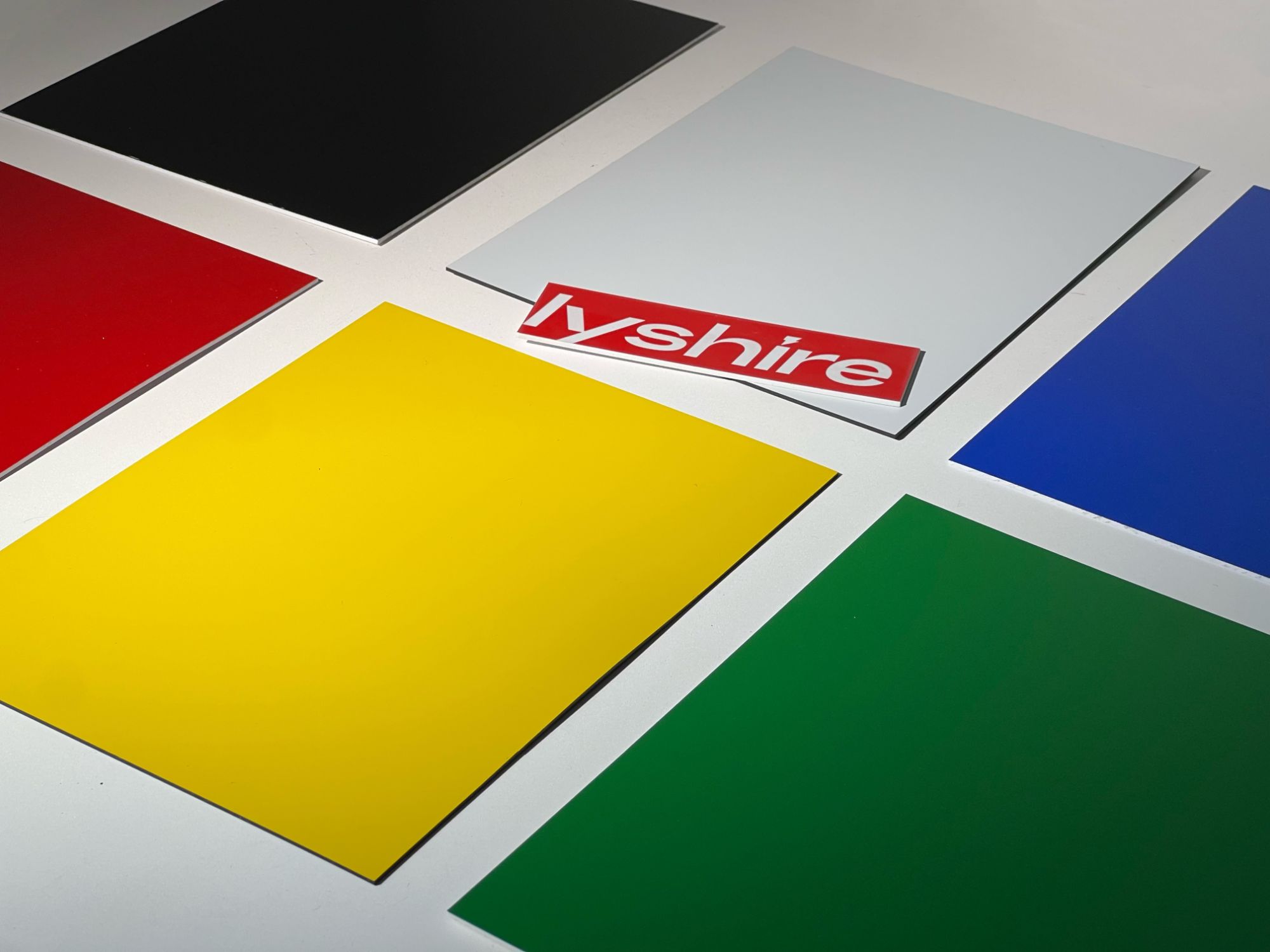
Acrylic is the workhorse—cast and extruded variants for different engraving contrasts—but we also handle polycarbonate for impact-resistant labels, PETG for forming-grade pieces, and specialty layers like reverse-engravable cap stock. Even composites with a dark core and light cap for backlit signs are doable in small batches.
You’d share the intended laser type, desired finish, and a drawing or concept. We then create a material proposal, often sending 3–5 different swatches with varied surface textures or pigmentation. Once you run your tests and pick a winner, we interpret that into production parameters—no guesswork, just translation of your successful test into scaled manufacturing. Lead times flex based on complexity but we flag anything risky early.
Surprisingly, the factory setup is built around quick changeovers. We do runs for boutique signage shops, model makers, and even individual designers prototyping a single product line. Minimums are more about the economic batch of raw resin than a gatekeeping number—so a few dozen sheets is often perfectly workable.
Static buildup influencing powder coating uniformity, subtle die lines transferring from polishing rolls, or a pigment batch shifting the laser’s absorption curve slightly. We’ve learned to pre-treat surfaces with anti-static baths, cross-hatch test adhesion religiously, and maintain spectro readings on every pigment delivery. It’s a constant dance between chemistry and physics.
The sheet formulation itself includes modifiers that promote clean thermal decomposition along the cut line without excessive pooling. Beyond the recipe, every production lot goes through a panel test on a 60-watt CO2 laser at three speed/power settings. We photograph the kerf and measuring burr height under a microscope before shipping. If it’s not crisp, it doesn’t leave.
Absolutely. Some clients want a low-tack paper masking that doesn’t curl under heat, others need a film with a printed grid for alignment, or perforated tear-off strips. We even embed light-tack adhesive on the backside of certain sheets so they can be positioned peel-and-stick before final laser processing—saving steps later.
Conclusion
Stepping into our facility, the journey of every laserable plastic sheet begins with a careful selection of raw materials—we work with trusted global suppliers to source premium acrylics, polycarbonates, and specialty polymers, ensuring consistent clarity, color saturation, and structural integrity. The transformation from stock sheet to a precisely tuned laser-ready surface leans heavily on material science: our technical team tweaks polymer formulations and surface coatings to optimize energy absorption and minimize heat-affected zones, resulting in crisp, clean engravings that preserve intricate details. Once the material specs are locked in, custom fabrication takes over—clients collaborate directly with our engineers to translate designs into exact dimensions, edge finishes, and masking options, all while keeping turnaround times tight. This blend of artisan-level care and automated precision keeps rejects low and client satisfaction high.
Beyond production, quality control is woven into every stage rather than tacked on at the end; we run real-time laser tests under varied power and speed settings, measuring depth consistency and edge sharpness against stricter-than-industry benchmarks. The result is a sheet that performs reliably across vastly different applications—from architectural models and signage to medical device overlays and custom electronics panels—without surprises. At the same time, we’ve embedded sustainability into the workflow: offcuts get reground and re-extruded into new sheets, while our closed-loop cooling and extraction systems drastically cut waste and emissions. Whether you’re prototyping a one-off art piece or scaling up for mass production, our process delivers the accuracy and adaptability your project demands, without compromising on the environment.
Contact Us
Contact Person: Tina Hou
Email: [email protected]
Tel/WhatsApp: +86 17816238685
Website: https://www.lyshire.com