

International Customs Data Platform: Your Gateway to Global Trade Insights
2026-11-02
What if you could see exactly what your competitors are importing, where demand is rising, and which suppliers are gaining ground—weeks before anyone else? That’s the promise of an international customs data platform, your gateway to global trade insights that actually move the needle. But not all platforms are equal. Tendata goes beyond basic shipment records, turning complex trade data into strategic moves you can act on today.
Customs Data Feeds That Refresh While You Work
Customs data feeds that refresh while you work take the guesswork out of tracking shipments. Instead of pausing to re-run a report or waiting for a scheduled batch update, the information simply stays current on your screen. It means you can watch a container clear a port or a tariff code shift as it happens, without ever leaving the task at hand.
This kind of live integration works best when it pairs with your existing workflow tools. A sidebar that quietly updates every few minutes, a notification that only pings when a flagged entry changes, or a dashboard that reflects the latest entries from multiple sources — all make the data feel less like a separate task and more like background support. The key is that the refresh happens without interrupting your focus.
For teams that manage time-sensitive imports or monitor compliance, this real-time cadence removes the usual lag between data pull and decision. You can spot a missing declaration or a sudden change in duty rates early enough to act, rather than finding it in a weekly summary. It turns customs data from a static reference into something you can actually lean on throughout the day.
Tariff and Duty Answers Without the Endless Tabs
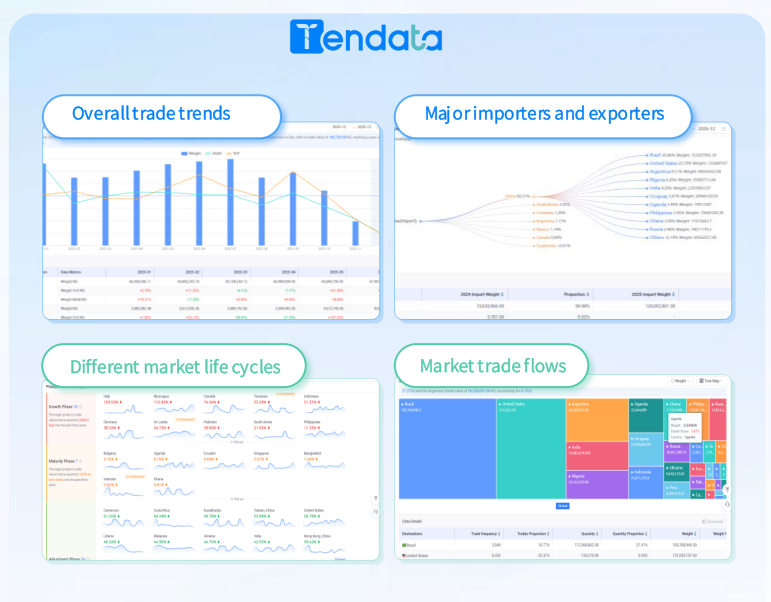
You shouldn't have to stitch together duty rates from six different browser tabs. This pulls the relevant tariff code, duty percentage, and any extra fees into one clear view, so you can see the landed cost without the copy-paste marathon.
The frustrating part isn't just finding the number, it's knowing whether that number is still current. Duty rates shift with trade agreements and HS code updates. Instead of digging through customs notices, you get the answer straight from the source, with the date it was last verified, so you're not basing a quote on outdated figures.
For teams handling multiple product categories, the old way meant repeating the same lookup for every SKU. Here, you can check several items at once and compare duty implications side by side. No tab groups, no spreadsheet mapping, just the answer in the same place you're already working.
See Which Trade Lanes Are Heating Up Right Now
Right now the usual volume maps are shifting faster than most routing guides can keep up. Intra-Asia sailings, especially out of North China into Southeast Asia, have tightened noticeably in the past month, driven by restocking ahead of late-summer production cycles. Spot rates on those lanes are climbing in weekly increments rather than the usual seasonal drift, which suggests capacity is being pulled toward more profitable backhauls.
Transatlantic eastbound is another lane that has quietly flipped from soft to firm. Bookings from the U.S. East Coast into North Europe have filled earlier each week, with some carriers rolling cargo to the next sailing because of weight restrictions. The shift is partly tied to project cargo and a thinner-than-expected blank sailing schedule, but the practical effect is that shippers who used to have bargaining room are now locking rates two to three weeks out.
There are also pockets of heat in the Middle East and South Asia, where regional feeders are running at near full utilization. What makes this different from a broad peak season is the unevenness: one corridor will spike while an adjacent lane stays flat. Watching daily rate sheets and equipment availability by port pair has become a better leading indicator than any quarterly forecast.
Turn Filing Noise Into a Clear Supply Picture
Most supply chain teams drown in filing data. Customs entries, carrier manifests, and compliance documents pile up fast, each one carrying small but critical differences in product descriptions, quantities, or country of origin. On their own these records look like administrative noise. Together, after cleaning and matching, they reveal exactly where goods are moving, how long clearance is taking, and which lanes keep hitting exceptions.
The trick is not to read every filing. It is to extract the few fields that matter for visibility: importer of record, tariff code, port, container number, and estimated arrival. Once those fields are normalized across sources, a dull stack of forms becomes a live map of inbound flow. You start to see delays before they are reported, spot repeated misclassifications, and compare customs brokers on actual clearance speed instead of vague promises.
That shift changes daily work. Planners stop chasing emails and start working from a single, refreshed picture of what has cleared, what is still sitting in review, and what needs attention before it becomes a stock-out. The noise does not disappear, but it stops running the conversation.
Compliance Flags You Can Fix Before They Cost You
A lapsed food handler card, an expired insurance certificate, or a missing safety data sheet rarely feels urgent—until an inspector walks in. These are the compliance flags that quietly accumulate on the operations side while owners focus on customers and payroll. They don't announce themselves, but they compound.
The good news is most of these flags are fixable in an afternoon. Pull every permit, license, and training record into one spreadsheet. Assign a single person to track renewal dates, and set reminders 60 days out. For physical postings—labor law notices, evacuation maps, inspection tags—do a monthly walkthrough with a phone camera. The goal is not perfection; it's catching the small stuff before a third party does.
Fixing these flags now costs almost nothing compared to the alternative. A late renewal might trigger a fine, a stop-work order, or a rejected insurance claim. Worse, it signals to clients that your attention to detail is optional. Spend one hour a month on compliance hygiene and you remove the easy targets that regulators and auditors are trained to find.
Watchlists for Any Product, Country, or Competitor
Most dashboards force you to choose between tracking a product, a geography, or a company. That split feels artificial when real supply chains blur those lines. Here, a single watchlist can follow a specific component across three countries, flag the importers making sudden moves, and still leave room to watch a competitor's new facility—all without switching screens.
The setup is deliberately loose. You might start with a tariff code, add a country filter, then decide to exclude your own shipments and see only what rivals are doing. Watchlists update as fresh records land, so when a new supplier pops up in Vietnam or a competitor starts buying double the usual volume, it shows up in the same feed. No need to run separate searches or stitch together spreadsheets.
Because every team watches different signals, you can rename, reorder, or archive watchlists without breaking the underlying data. A procurement lead focuses on price shifts for raw materials; a legal team tracks country-level enforcement actions; a strategy group keeps an eye on a competitor's product launches. Same tool, three entirely different views.
FAQ
You get access to import and export records from over 200 countries and territories. Each record includes HS codes, product descriptions, shipment values, quantities, importer and exporter names, and countries of origin or destination. The archive goes back five years, so you can do serious trend analysis.
Most country feeds refresh monthly, but some major traders like the US and China are updated weekly. We also adjust for typical customs publication delays and clean out duplicate or misreported entries before they hit your dashboard.
Absolutely. Filter by a specific HS code, pick a target country, and you'll see active importers or exporters with their shipment histories. It's a solid way to shortlist potential partners without relying on third-party directories.
We cover the vast majority of global trade by value, including all G20 nations and key emerging markets. A few smaller countries don't publish their own customs data, but we often fill those gaps using mirror statistics from their trading partners.
Raw files are messy—company names are spelled five different ways, units don't match, and HS codes vary by year. We standardize all of that, link related entities, and give you a searchable interface plus an API. You spend time analyzing, not cleaning.
We use a mix of automated entity resolution and manual review. The system recognizes that 'ABC Trading Co.' and 'ABC Trading LLC' in the same city are probably the same buyer, and it merges their records. It's not perfect, but we're transparent about confidence scores.
We provide record-level detail where available, so you can see individual shipments with dates, ports, and declared values. Some countries only release aggregate data, and for those we show monthly totals. You can toggle between both views.
Conclusion
Trade data usually shows up late, scattered across spreadsheets and PDFs, long after the market has moved. The International Customs Data Platform is built to close that gap. Its customs feeds refresh while you are working, so shipment volumes, values, and unit prices reflect what is happening now rather than last month. Tariff and duty questions no longer require tab after tab of government schedules and trade agreements; you can pull up rates and rules in the same view you use for pricing. At the same time, the platform shows which trade lanes are gaining volume and which are cooling, helping you spot opportunities in specific product-country pairs before they become obvious to everyone else.
Raw filing data often hides the story. This platform cleans and links those records so you see a coherent supply picture: who is moving what, through which ports, under which incoterms. Compliance risks surface as fixable flags, not after-the-fact penalties. You can see, for example, that a supplier's documentation pattern has shifted or that a duty code is being used inconsistently across shipments. Watchlists make this even more useful because they let you track any product, any country, or any competitor without running repeated searches. New entries simply appear as they arrive. Over time, the platform works like a quiet research desk that keeps global trade activity in view without demanding constant manual effort.
Contact Us
Contact Person: Grace
Email: [email protected]
Tel/WhatsApp: +86 18721992033
Website: https://www.tendata.com