OEM Landing Craft Barge: Custom Solutions for Marine Transportation
2026-07-12
When standard vessels don’t fit the mission, Allheart steps in with custom landing craft barges that redefine marine transport. From heavy cargo to specialized operations, each OEM solution is built from the keel up to match your exact needs — no compromises, no cookie-cutter designs. See how tailored engineering delivers performance that off-the-shelf options simply can’t.
Tailored Hulls, Not Templates: How We Shape Your Landing Craft
Every mission has its own rhythm, and a generic hull simply can’t keep up. We begin by stripping away assumptions, focusing instead on the specific demands of your operation—whether it’s navigating shallow riverbeds, enduring corrosive saltwater, or carrying unconventional payloads. This isn’t about tweaking an existing design; it’s about letting your requirements dictate every curve and seam from the very first sketch.
Our process merges naval architecture with hands-on craftsmanship. We shape each plate and frame to match the precise load balance and handling characteristics you need, using a blend of advanced modeling and time-tested fabrication techniques. The result is a hull that feels less like a piece of equipment and more like an extension of your team’s intent—responsive, resilient, and molded entirely around your operational reality.
Where Steel Meets Strategy: Engineering for Real Marine Work
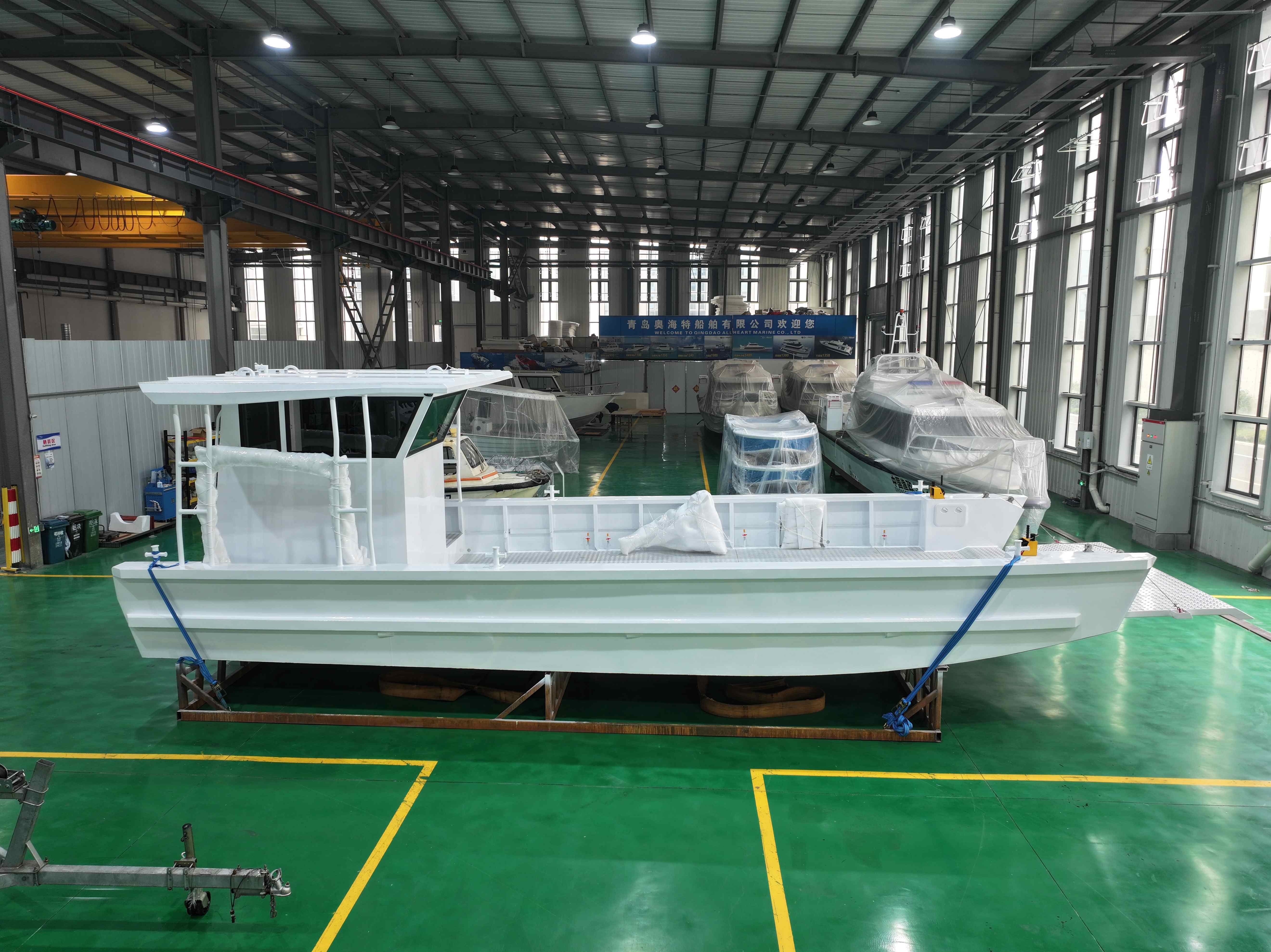
Every bolt tightened and weld laid in marine construction carries a story of compromise between brute material strength and the cunning of ocean forces. It’s not just about building something that floats—it’s about designing for the thousand unexpected ways water can find a weakness. The real work happens at the intersection of metallurgy and foresight, where corrosion allowance isn’t a formula but a hard-earned lesson from hulls that limped back to port.
In practice, this means the steel spec is only the starting point. Strategic engineering pulls in factors that no spreadsheet comfortably captures: how a crew will realistically maintain a coating in a cramped ballast tank, or the way a slight change in structural geometry could turn routine inspection into a nightmare. It’s a dialogue between the predictability of code and the messiness of actual seafaring—where a designer’s choice might quiet a vibration that only the seasoned chief engineer could feel in his boots.
That’s why the best marine projects are led by teams who treat the sea as a demanding colleague, not just an environment. They engineer systems that can take a beating from a North Atlantic storm, yes, but also ones that a sleep-deprived deckhand can repair with a wrench and sheer determination. When steel meets strategy, the goal is never perfection on paper. It’s resilience that holds together long after the calculations have been forgotten.
From Blueprint to Breakwater: The Seamless OEM Journey
Every great breakwater begins as a simple line on a screen. In our OEM approach, that initial blueprint isn’t just a static design—it’s the living heart of a process where engineering intent flows directly into production reality, skipping the usual translation errors that plague traditional handoffs.
From material selection to final assembly, each step mirrors the original vision without the friction of constant back-and-forth. Our teams work within the same digital thread, so the structural integrity you envisioned isn’t compromised by misinterpretation. It’s a quiet collaboration where the blueprint doesn’t just inform the build—it becomes the build.
This seamless journey means that when the breakwater finally meets the waves, there’s no surprise in its performance. It stands exactly as intended, a testament to a process where the distance between idea and installation is measured not in delays, but in deliberate, uninterrupted progress.
Quiet Strength: Materials and Methods That Defy Salt and Stress
In coastal construction and industrial settings, the relentless assault of salt and mechanical stress demands materials that endure without fanfare. Engineers often turn to duplex stainless steels, where a dual-phase microstructure of austenite and ferrite delivers exceptional resistance to chloride-induced pitting while maintaining high tensile strength. This quiet performer thrives where standard grades falter, such as in desalination plants and offshore platforms, thanks to its low molybdenum content that cleverly balances cost and corrosion defiance. It isn’t about flashy alloys but about choosing the right crystalline dance to shrug off decades of saline corrosion and cyclic loading.
Beyond metallurgy, protective coatings have evolved into silent guardians. Fusion-bonded epoxy, applied as a dry powder that melts and cures into a seamless barrier, creates an almost hermetic seal on rebar and pipelines. Unlike traditional paints that crack under thermal stress, this thermoset polymer flexes with the substrate, absorbing strain while repelling chloride ions. On concrete, crystalline waterproofing admixtures take a different tack: they grow needle-like crystals within capillary pores when moisture appears, self-healing micro-cracks before they can widen into structural headaches. These methods don’t shout for attention—they just work, decade after decade.
Uncharted Waterways, Uncommon Answers: Specialized Applications
There’s a quiet revolution happening where water meets ingenuity—far from the well-trodden paths of conventional hydrology. In the realm of specialized applications, uncharted waterways aren’t just geographical curiosities; they’re testing grounds for uncommon answers. Think of floodplain reconnection projects that use dormant side channels to absorb seasonal surges, or urban stream daylighting efforts that resurrect buried creeks to cool heat-stressed neighborhoods. These aren’t off-the-shelf fixes. Each demands a bespoke blend of ecological intuition, local materials, and a willingness to learn from the water itself, rather than forcing it into rigid templates.
Sometimes the most elegant solutions emerge from constraints that would stump standard engineering. Take the restoration of mangrove-lined estuaries in Southeast Asia, where flexible wooden piling systems mimic natural root structures to stabilize sediment without concrete. Or consider high-altitude peatland rewetting, where simple check dams made of native stone slow erosion and revive ancient carbon sinks. The common thread? A departure from one-size-fits-all thinking, replaced by deep observation and adaptive design. Practitioners often speak less about “controlling” water and more about “reading” it—deciphering subtle cues that reveal how a forgotten watershed once functioned.
What makes these applications truly specialized is their fusion of old wisdom with modern precision. Local fishing communities might contribute generations of tidal knowledge, paired with lidar mapping to pinpoint subtle elevation shifts. In arid regions, “water harvesting” reshapes terrain into micro-catchments that capture every rare rainfall, using techniques refined over millennia. The results rarely make headlines, but they quietly outperform—recharging aquifers, buffering coastlines, and stitching fragmented habitats back together. In the end, the uncommon answer is often the one that asks a better question: not how to conquer the water, but how to partner with it.
Beyond Delivery: The Long-Term Partnership That Keeps You Afloat
A true logistics ally does more than move goods from point A to B. It embeds itself in your operational rhythm, anticipating bottlenecks before they surface and crafting contingency strategies that keep your supply chain resilient. From monitoring geopolitical shifts to adjusting routes on the fly, this partnership ensures your business never misses a beat.
The value unfolds in the quiet moments—when inventory fluctuations threaten your schedule, and a single call redirects shipments seamlessly. It’s about having a team that knows your preferences without being told, that suggests improvements based on data trends, and that treats your success as their own metric.
Ultimately, it’s the shared vision that keeps you afloat amidst market turbulence. While others treat logistics as a transactional necessity, this enduring collaboration transforms it into a strategic advantage, giving you the stability to focus on growth rather than firefighting.
FAQ
It's a purpose-built vessel designed for amphibious operations, engineered and manufactured directly by the original equipment maker to fit your specific transport requirements.
Tailoring the design to your cargo, route, and operational conditions eliminates wasted space and enhances safety, giving you a vessel that performs precisely as needed without compromise.
Yes, their shallow draft hulls allow beach landings and river navigation, while the robust construction ensures stability and seaworthiness in deeper coastal waters.
Anything from construction machinery, vehicles, and modular buildings to bulk materials, containers, and project cargo – the deck layout and reinforcements are custom-fitted to your loads.
Absolutely. You can integrate ramps, cranes, winches, spud legs, accommodation units, or any equipment needed for your specific operations.
OEM direct manufacturing means tighter quality control from steel cutting to delivery. You get a vessel built to your specifications with full traceability and dedicated after-sales support.
It varies based on complexity and size, but usually ranges from a few months for a standard design adaptation to longer if it involves new engineering. Early engagement helps lock in a realistic schedule.
Both options are often possible. Some builders offer lease arrangements or chartering solutions, especially if you need temporary capacity without a full capital investment.
Conclusion
Every OEM landing craft we deliver begins with a blank slate and a conversation. Rather than forcing your project into a pre-existing mold, our naval architects start from the keel up, shaping hull forms that match precisely what your waterways and workloads demand. Deadrise angles, beam ratios, and deck layouts are all dialed in through iterative design, ensuring optimal stability under heavy equipment or silty shallows where template designs founder. This isn't about ticking boxes; it's about creating a vessel whose lines actually work for you, whether you're hauling construction materials onto a soft riverbank or ferrying supplies across a choppy harbor.
That tailored engineering extends into every plate and weld. We build with steel grades and protective coatings chosen for decades of salt spray and scraped gravel, not just initial cost. Behind the quiet resilience of the hull is a process that fuses blue-water fabrication standards with in-the-field insight, so the craft that leaves our yard is already battle-tested for its real marine work. Commissioning is not a handoff but the start of a long-term relationship: we stay alongside with service, retrofit support, and the kind of uncommon problem-solving that turns one-off challenges into repeat solutions. When your route map includes uncharted waterways or your mission demands something no standard barge can answer, our fully OEM approach ensures you get a landing craft that is not just another vessel, but a decisive tool shaped to your reality.
Contact Us
Contact Person: Benny Hu
Email: [email protected]
Tel/WhatsApp: +8618354225697
Website: https://www.allheartmarine.com/