

OEM Ring Main Unit Fundamentals and Key Selection Criteria
2026-11-16
When evaluating medium-voltage switchgear for compact secondary distribution, the OEM ring main unit often becomes the quiet workhorse—yet selecting the right one is rarely a simple spec-sheet exercise. From insulation medium to fault interruption ratings, small decisions ripple through safety, footprint, and lifecycle cost. In this guide, we break down what actually matters, drawing on real-world insights from Lugao to help you match RMU fundamentals to your operational reality.
The Real Job of a Ring Main Unit in Modern Distribution
Ring main units often get filed under “switchgear,” but that label misses the point. Their actual role is less about switching and more about keeping a section of the network alive when something upstream fails. In a modern distribution loop, the RMU sits at the junction where two feeders meet, letting operators isolate a fault without plunging an entire neighborhood into darkness. It’s a quiet piece of engineering that earns its keep during the worst possible moments.
What makes this job different from a simple circuit breaker is the built-in redundancy. A conventional breaker protects one line; an RMU manages the relationship between several. When a cable fault occurs, the unit’s load break switches allow the faulty segment to be carved out, while the healthy portion continues to receive power from the alternate feeder. This isn’t just convenience—it’s the difference between a five-minute interruption and a multi-hour repair window. Utilities depend on that flexibility to meet reliability targets that customers now take for granted.
Beyond fault handling, the modern RMU also carries a growing measurement burden. With distributed generation and bidirectional flows becoming normal, the unit has to report voltage, current, and fault indicators back to a control room. That transforms it from a passive metal box into an active node in the distribution automation system. The real job, then, is not merely routing power—it’s giving grid operators the visibility and control they need to keep a complex, shifting network balanced.
Components That Decide Whether an RMU Survives Its First Fault
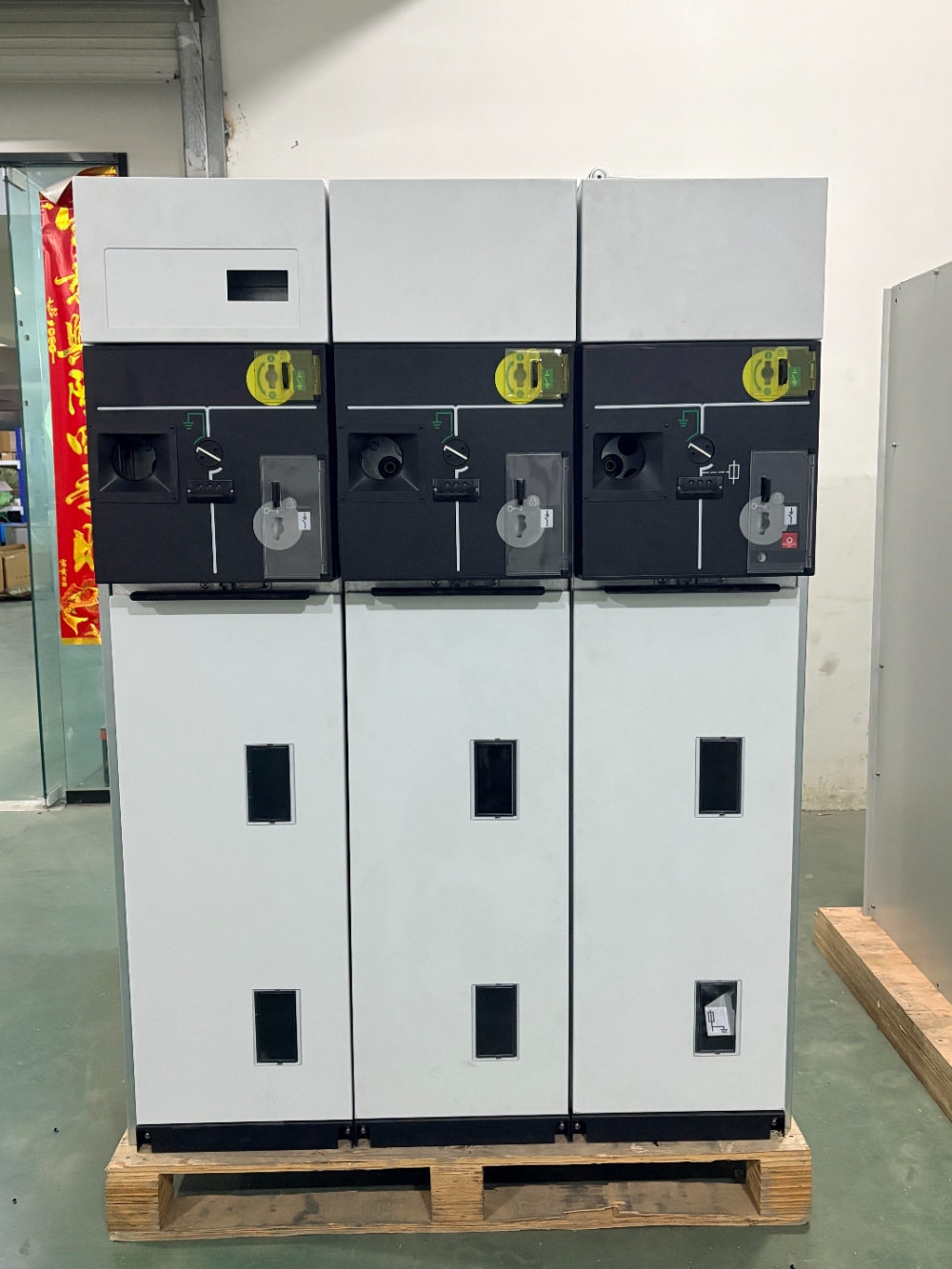
The first fault a ring main unit sees is often its last if the protection chain is slow or poorly coordinated. A vacuum circuit breaker with a tripping time under 60 milliseconds can make the difference between a contained event and a ruptured tank. The relay driving that breaker needs to be set with tight pickup thresholds and no intentional delay on phase-to-phase faults. Without that speed, the arc energy released inside the enclosure rises sharply, and no amount of rugged steel will hold back the pressure wave.
Insulation and pressure relief are equally decisive. SF6-filled compartments rely on gas density monitors that must not be ignored or bypassed; a drop in pressure before the fault is a warning that the dielectric strength is already compromised. The pressure relief flap or burst disc has to open at the designed value, usually a few hundred millibars above normal operating pressure. If it sticks, the internal arc turns the RMU into a shrapnel hazard, not a switchgear asset.
Finally, the fuse-switch combination in many RMUs acts as a silent guardian. Current-limiting fuses interrupt the fault before the peak current is reached, sparing downstream cable and upstream transformer from mechanical stress. But the fuse holder, striker pin, and trip linkage must all be in correct alignment after installation. A single bent linkage or mismatched fuse rating can leave the RMU unable to clear the first fault, and that failure is rarely repairable on site.
Insulation Technology Choices Beyond the SF6 Debate
The conversation around insulating gases has long been dominated by sulfur hexafluoride, but a quieter shift is underway in switchgear design. Vacuum interrupters, once limited to medium voltage, are now being paired with solid or alternative gas insulation to handle higher ratings. This combination reduces the reliance on any single gas while sidestepping the most contentious trade-offs.
Solid insulation systems built from epoxy or thermoplastic composites offer another route. These materials remove the need for pressurized gas altogether in certain compact designs, though they demand careful thermal management and long-term aging data. Field experience remains thinner than for SF6, so asset managers weigh that uncertainty against the regulatory pressure to phase down fluorinated gases.
Dry air and technical air mixtures, sometimes blended with small amounts of fluoronitriles or fluoroketones, are gaining ground in distribution and transmission equipment. The real choice is not simply "SF6 or not," but which failure modes, temperature ranges, and maintenance realities a utility can accept. That pragmatic framing reshapes how engineers compare options beyond the usual political divide.
Reading Voltage and Short-Circuit Ratings Without Guesswork
Voltage ratings often hide in plain sight on the equipment nameplate, but the real trick is knowing which number applies to your installation. A breaker stamped with 600VAC may still be rated for lower DC voltage, and that derating curve isn't always next to the logo. Look for the interrupting rating separately—some manufacturers list it as symmetrical amperes at a specific voltage, others use a table buried in the manual.
Short-circuit ratings demand the same scrutiny. The SCCR on a control panel sticker isn't a single magic number; it depends on the weakest component in the path. Instead of assuming the main breaker sets the limit, trace the series combination. Many fuses are tested in pairs, and a mismatched upstream-downstream arrangement can leave you with a silent downgrade.
When the plate is missing or faded, don't lean on memory. Measure the line voltage at the service entrance under load, then cross-reference that with the utility's available fault current letter—not the transformer kVA alone. A 75 kVA transformer can deliver anywhere from 10kA to over 40kA depending on impedance and secondary length, so treat any guess as a placeholder until the data is verified.
How Site Conditions Reshape Your RMU Specification
The moment you step onto a site, the abstract specs on paper start to bend. A factory floor with grinding dust demands a different enclosure rating than a coastal substation breathing salt air. The actual conditions—not the generic datasheet—dictate whether your RMU needs extra corrosion resistance, wider cable compartments for oversized conductors, or a ventilation scheme that won't clog by week two.
Space is rarely what the drawings promise. A basement corner with a low ceiling forces you to rethink top-entry bushings and front-access panels. Narrow doorways mean a standard 3-panel unit might arrive in pieces, or you might choose a compact design that sacrifices internal elbow room for a few centimeters of clearance. These constraints reshape the specification quietly, pushing you toward a layout that fits the physical world rather than the ideal one.
Then there's the human factor—the people who'll operate and maintain the gear under real conditions. If the site runs hot all year, derating factors creep into the busbar calculations. If it floods seasonally, base frame height becomes non-negotiable. The best specifications read like field notes: aware of ambient temperature, cable bend radii, and the way dust settles into every unsealed gap. That's how a truly site-ready RMU takes shape.
Interlocks, Grounding, and the Safety Details Often Overlooked
Most operators assume an interlock is either engaged or not, but the reality is far messier. A limit switch wired into a control loop can be defeated by a bent actuator, a loose terminal, or a bypass key left in place after maintenance. What gets missed is the logic layer: a safety relay that forces a restart sequence after an interlock trip might be bypassed by a well-meaning technician trying to speed up a job. The overlooked detail is not the switch itself but the entire chain of conditions that must remain true for the interlock to actually protect someone. If the reset button is accessible without walking the line, or if the PLC allows a forced output, the interlock is only as good as the least disciplined person on shift.
Grounding is often treated as a box-ticking exercise—wiggle the wire, read a low ohm value, move on. But a ground path can degrade in ways a simple resistance check won't reveal. Corrosion under a lug, paint left on a mounting bracket, or a daisy-chained ground that carries noise from a variable frequency drive all create hazards that show up only under fault conditions. The overlooked detail is the bonding between metallic enclosures: a door hinge might pass current fine when new, but after years of wear and grime, that hinge becomes a high-impedance point. A proper inspection means looking at the entire path, not just the final connection to earth.
Beyond interlocks and grounding, there are dozens of small details that never make it into the headline risk assessment. The label that says "disconnect before opening" has worn off; the arc flash boundary markers are faded to illegibility; the lockout hasp doesn't fit the breaker because someone replaced the breaker with a different model. These aren't dramatic failures—they're the slow erosion of safety systems under daily use. A plant can pass an audit while these details rot, because auditors look for major violations, not a sticky emergency stop button or a missing screw on a terminal cover. The truly overlooked safety detail is the person who notices these small things and has the authority to stop work, order a replacement part, and refuse to accept "it's been fine for years" as a valid engineering judgment.
FAQ
An OEM ring main unit is a compact, factory-assembled switchgear package used mainly at 12 kV to 24 kV levels in ring-type distribution networks. It lets utilities or industrial operators isolate a faulty cable section and restore supply from the healthy side without a long outage. Because it is produced by an original equipment manufacturer, the unit can be branded or integrated into a larger system by another supplier while keeping consistent build quality and test certification.
The most critical values are the rated voltage, which should match the network nominal voltage with a margin for temporary overvoltages, and the rated normal current, typically 630 A for feeder rings or 1250 A for transformer incomers. You also need to verify the short-time withstand current and duration, often 20 kA for 3 seconds, and the internal arc classification to ensure safe operation under fault conditions.
Internal arc classification indicates how well the unit can contain the pressure, heat, and gases from an internal fault without endangering nearby personnel. Most modern RMUs are tested to IEC 62271-200 and rated AFL or AFLR, which tells you the accessible sides are protected. Buyers often refuse equipment without this rating because a failure inside a metal-enclosed switchgear can be lethal if the enclosure bursts or vents hot gases toward operators.
A fixed RMU is cheaper and simpler, with a set number of incoming and outgoing ways, but it cannot be expanded later. An extensible design allows you to add more feeder or transformer modules on site as load grows, which avoids replacing the whole unit. For networks with uncertain load development or frequent customer connections, extensible RMUs typically provide better lifecycle value even though the initial cost is higher.
Outdoor units need a higher IP rating, usually IP54 or above, plus corrosion-resistant enclosures and cable boxes that can handle wet and dusty conditions. Indoor RMUs can use a lower protection class but still need proper ventilation if they contain SF6. You should also check the operating temperature range, altitude derating, and whether the foundation or pad-mounted arrangement matches the site access for cable termination and future maintenance.
Vacuum circuit breakers offer resettable protection with no fuse replacement after a fault, making them better for frequent operations or automated networks. Switch-fuse combinations are still used for transformer protection because they are cheaper and can limit high fault currents, but every fault requires a fuse change. A vacuum breaker module also allows remote tripping and reclosing, which is becoming essential in smart grid applications.
Adding current and voltage sensors, a motorized operating mechanism, and a remote terminal unit raises the purchase price, but it reduces outage duration and avoids dispatch of field crews for simple switching. Condition monitoring of gas pressure, contact wear, and cable temperature enables predictive maintenance instead of fixed time-based servicing. Over a 20 to 30 year service life, the avoided outage penalties and lower maintenance costs often offset the higher upfront investment.
Conclusion
Selecting an OEM ring main unit starts with understanding that its real value is not just switching lines but maintaining continuity in modern distribution networks. The unit's ability to ride through a first fault depends heavily on component quality—circuit breakers, disconnectors, and fault indicators—each chosen for mechanical endurance and reliable operation under stress. Beyond the familiar SF6 debate, insulation options like dry air, solid dielectric, or vacuum interrupters now compete on safety, footprint, and maintenance demands. Reading voltage and short-circuit ratings requires cross-checking system grounding, peak current, and arc duration, not simply matching a datasheet number. Site conditions further reshape specifications: altitude derating, humidity, pollution levels, and restricted access all force adjustments to enclosure ratings and cooling assumptions.
Interlocks, grounding switches, and the often-overlooked safety details separate a robust RMU from a merely compliant one. Cable test points, padlock provisions, and visible isolation gaps reduce operator risk during maintenance or emergency switching. A thorough selection process weighs these human factors alongside technical ratings, because a unit that fails mechanically or confuses a technician can compromise an entire feeder loop. The most defensible OEM choices come from mapping actual fault scenarios, environmental constraints, and maintenance routines to specific component behaviors rather than relying on generic marketing claims.
Contact Us
Contact Person: Doreen
Email: [email protected]
Tel/WhatsApp: 8618057712366
Website: https://www.liugaopower.com/