

Travertine Flexible Stone Original Manufacturer Shares Expert Tips for Choosing Durable Flexible Stone
2026-08-21
Choosing durable flexible stone isn’t about chasing the lowest price—it’s about knowing what actually holds up. As an original manufacturer of travertine flexible stone, Magic Stone cuts through the noise with practical, field-tested tips that help you spot quality before installation.
What Actually Causes Flexible Stone to Degrade in the First Five Years
Most early failures in flexible stone don't come from the stone surface itself. They start at the bond line. Flexible stone moves with daily temperature swings and minor structural settling, but when it's installed like a rigid tile, the adhesive bears all that movement. Stiff mortars or poorly primed substrates create shear stress that shows up as lifted edges, bubbles, and fine cracks within the first two or three years.
Water gets the blame more often than it should, but for a good reason. Any small gap around windows, an unsealed seam, or a missing flashing detail lets moisture slip behind the panel. Because the veneer is so thin, that trapped water has no easy way out. In freezing climates the expansion cycle separates the layers; in warm damp climates it feeds efflorescence and mold that slowly eat into the resin binder.
Sun exposure and detail choices round out the early degradation triggers. Ultraviolet light breaks down the polymer face and fades mineral pigments, especially on walls that face south or west and soak up hours of direct sun. If the original installation skipped movement joints, used a generic primer, or didn't seal exposed edges, those shortcuts surface as hairline cracks, color drift, and delamination well before the five-year mark.
The Backing Fabric Test Most Buyers Skip Until It Is Too Late
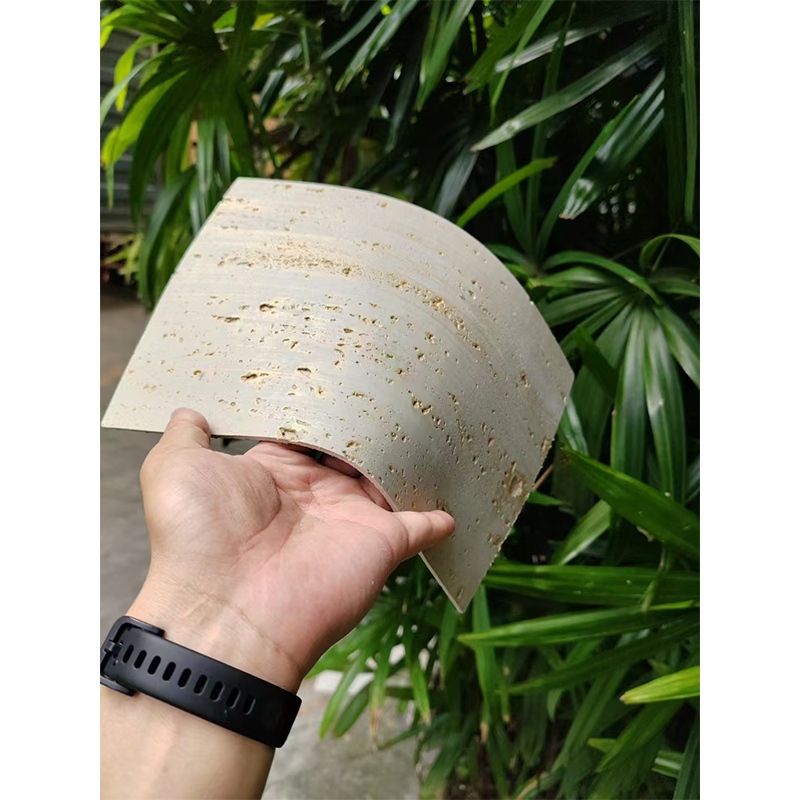
Most people run their fingers over the face of a fabric and call it a day, but the real story is on the underside. Flip the sample over and give the backing a good rub between your thumb and forefinger. If it feels thin, scratchy, or loosely woven, that's your first warning sign. A decent backing should have some grip and density, not feel like it'll disintegrate after one season of use.
Then there's the stretch test. Hold the fabric by opposite corners and give it a gentle tug along the bias. Watch what the backing does. If it separates from the face or you see little cracks forming, walk away. Quality backing stays bonded and moves with the fabric, even when you're pulling it tight across a frame or around a cushion. That's the kind of thing you won't notice in a showroom but will absolutely curse six months later.
Dampen a hidden corner of the backing if the seller allows it, or at least check how it reacts to a drop of water from your fingertip. Cheap backings often pucker, bleed, or turn gummy when wet. That's a sign the fabric was never meant to handle real life spills or humidity. If the backing survives the damp test without drama, you're likely holding something that was built to last, not just to look good on a shelf.
Why Travertine Vein Depth Changes How Panels Handle Sun and Moisture
Vein depth in travertine is not just a visual afterthought; it dictates how the stone takes on sun and moisture. Deep, open veins act like tiny channels that pull water inward, while faint or tightly filled veins give moisture less room to travel. Under direct sunlight, those same open lines can become micro-expansion joints, letting heat move unevenly through the panel. The result is a material that behaves differently on a shaded patio versus a south-facing wall, even when the travertine comes from the same quarry block.
When panels carry deeper veining, especially in honed or tumbled finishes, the surface holds more texture and more places for morning dew or rain to linger. That lingering moisture can darken the veins first, creating a uneven drying pattern that shifts through the day. On lighter, heavily veined pieces, this can make the stone feel alive one hour and mottled the next. Installers who ignore vein depth often blame the sealer or the tile, when the real issue is how the natural fissures interact with the local climate.
In practice, deeper veins call for more careful slope and drainage planning, especially around pools or in humid regions. Panels with shallow, filled veins tend to dry faster and hold a more stable surface temperature, which makes them easier to manage in full sun. Choosing between the two is less about aesthetics and more about matching the stone's natural plumbing to the demands of the site.
A Quick On-Site Bend Test That Separates Durable Panels from Imitations
Grab a corner of the panel and give it a firm but controlled flex—maybe fifteen or twenty degrees past flat. A properly made panel should bow smoothly and spring back without leaving a crease, a crack, or a dull pop sound. Imitations tend to fail fast: the face layer may ripple, the edges may whiten, or you might feel the core snap before the panel even reaches a modest angle.
What you're listening and feeling for is a single, clean resistance. Durable panels flex as one unit because the skin and core are bonded under proper heat and pressure. Cheaper copies often hide a weak middle or a brittle adhesive, and the bend test exposes that in seconds. If the panel rebounds cleanly and the surface stays flat, it's likely built for real use. If it kinks, crackles, or stays bent, you're holding a lookalike.
Repeat the test on a cutoff or an uninstalled corner before you commit to a full inventory. It takes less than a minute, needs no special tools, and reveals more about lamination quality than a printed spec sheet ever will.
Matching the Right Adhesive to the Substrate Instead of Guessing
Adhesive selection fails most often when surface energy gets ignored. A low-energy substrate like polypropylene or powder-coated metal repels high-surface-energy adhesives such as cyanoacrylates, leaving beads that never wet out. Testing with a simple dyne pen or water break test reveals whether the surface will accept a pressure-sensitive tape or whether a primer, flame treatment, or a specialty acrylic with built-in low-surface-energy monomers is needed.
Porosity changes everything about bond formation. On bare wood, paper, or unsealed concrete, a thin instant adhesive can wick away from the joint before it cures, starving the bond line. Switching to a gap-filling polyurethane or a thickened epoxy keeps adhesive at the interface long enough to build strength. Conversely, on glass or polished metal, a flexible adhesive with high elongation absorbs thermal cycling stress far better than a brittle resin that will crack at the first temperature swing.
Mechanical loads and environmental exposure should drive final choice, not habit. An outdoor sign on aluminum faces UV, rain, and wind vibration, so a neutral-cure silicone or a toughened acrylic with UV stabilizers outperforms a general-purpose contact cement. Keeping a small set of adhesives matched to substrate families—porous, low-energy, high-energy, flexible—removes guesswork and cuts rework far more than chasing the strongest bond on a datasheet.
Where Corners and Edges Fail First and How to Reinforce Them
Most structural failures in everyday objects don’t start in the middle of a flat surface—they begin where two planes meet. A sharp 90-degree corner concentrates mechanical stress, making it a natural initiation point for cracks, chips, and fatigue. Coatings also pull thin at these transitions, leaving the underlying material exposed to moisture, impact, and abrasion. Once a small defect forms at a corner or along an edge, it tends to spread quickly because there is less surrounding material to absorb and redistribute the force.
You can see this pattern in painted drywall corners that crack within a year, plywood edges that swell after minor water contact, or 3D-printed parts that delaminate along layer lines at sharp angles. Edges handle more than their share of incidental contact—bumps from furniture, tools, shoes, and weather—yet they often receive the least protective treatment. The geometry works against you: an outside corner has exposed material on two sides and minimal support behind it, while an inside corner creates a stress riser that attracts tensile and shear loads.
Reinforcement starts with geometry. Rounding an inside corner or adding a fillet spreads stress over a larger area instead of letting it spike at a single line. For outside edges, consider chamfering or bullnosing, which removes the fragile sharp apex and gives coatings a better chance to build thickness. Where geometry can’t change, use physical reinforcement: metal or plastic corner beads under plaster, edge banding on furniture panels, epoxy fillets at joints, or fiber tape along vulnerable seams. In wood, metal, or polymer parts, adding even a small radius—often 10–20% of the material thickness—can double or triple the load before failure. For damp or high-wear environments, seal the edge with a flexible caulk or edge sealer and add a sacrificial wear strip. The goal is to give corners and edges the same level of protection as the flat areas, not less.
FAQ
It comes in thin, bendable sheets backed with a reinforced layer, so you can wrap it around curves, columns, and irregular surfaces without cracking. The stone itself is real travertine, just sliced much thinner and bonded to a flexible substrate.
Ask for the full production address, not just a sales office. A genuine factory will share batch records, material safety data sheets, and often welcome a video tour of the line. If they hesitate on any of those, you are probably talking to a trader.
A matte or honed surface hides scratches and daily wear far better than a polished one. Look for a factory-applied UV and abrasion-resistant topcoat, and confirm the coating is water-based so it does not yellow over time.
Bend the sample back and forth at least twenty times and see if the face cracks or the backing delaminates. Then rub it with a damp cloth and a little mild soap to make sure the color does not lift. A good sheet should stay intact and keep its color.
Yes, using the wrong adhesive is a big one. Flexible stone needs a polymer-modified thin-set or a dedicated flexible adhesive, never standard mastic or cheap drywall glue. Skipping the recommended primer on porous substrates also leads to peeling within a year or two.
It can if the manufacturer rates it for exterior application and you seal the edges properly. The key is preventing water from getting behind the sheet. Use a flexible, breathable sealer and avoid installing it below grade where standing water sits against the surface.
Stick to a soft microfiber cloth or sponge with warm water and a pH-neutral cleaner. Avoid acidic or alkaline products, stiff brushes, and power washers. Rinse with clean water and let it air dry to keep the topcoat from breaking down prematurely.
Look for a backing made from fiberglass mesh or non-woven fabric that resists tearing, and prefer sheets around 2 to 4 millimeters thick. Thicker is not automatically better; what matters is that the stone layer is evenly bonded and the edges do not fray when cut.
Conclusion
Most early failures in flexible stone come down to the backing fabric and the depth of the travertine veins, not the stone layer itself. A quick on-site bend test tells you more than a datasheet: fold a corner back and forth gently. If the backing cracks, delaminates, or shows loose fibers, that panel will not survive repeated sun and moisture cycles. Deep, pronounced veins look beautiful, but they create tiny water traps and uneven expansion points. Unless the backing is dense and the resin has fully penetrated those grooves, panels will cup or split within a few seasons. Buyers who skip the fabric check often end up replacing walls before the five-year mark.
Adhesive choice is another place where guessing leads to expensive repairs. The same panel will behave differently on cement board, plywood, or painted drywall, so matching the adhesive to the substrate matters more than brand loyalty. Corners and edges are where stress concentrates first. If you skimp on priming or leave cut edges unsealed, moisture wicks in and the panel starts to lift. A small investment in edge reinforcement and the right primer prevents most callbacks. Combined with a simple bend test and honest attention to vein depth, these steps separate durable flexible stone from imitations that fail just when the warranty expires.
Contact Us
Contact Person: Vito
Email: [email protected]
Tel/WhatsApp: 86 13088879266
Website: https://www.magicstonemcm.com